// Author 02 · Workout & Training Content
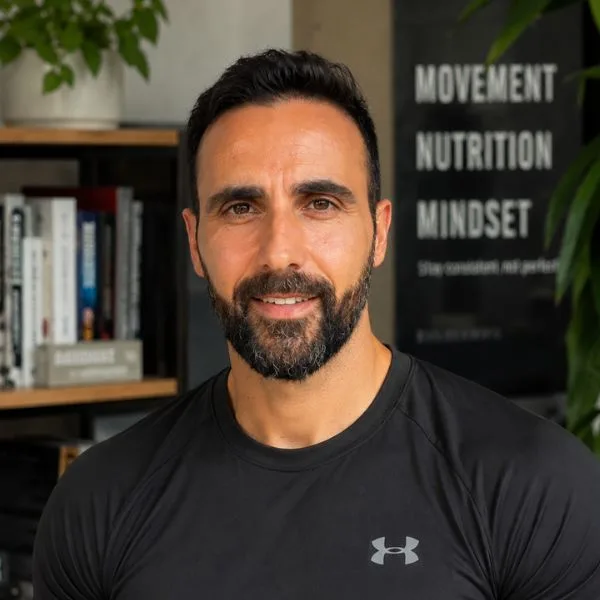
Marco Bellini
Strength & Bodyweight Training Specialist
EN · IT · ES · FR (reading)
✓ Reviews all workout & training content on NoGymLabI’ve been training without a gym for over a decade. Not because I couldn’t access one — because at some point in my mid-twenties, moving between cities for work every six to twelve months, I stopped being able to rely on one. And in trying to solve that problem for myself, I became genuinely fascinated by what’s actually possible with bodyweight training done intelligently, and what’s been left unexplored because the fitness industry isn’t particularly motivated to tell you that a pull-up bar and a floor might be enough.
The short answer, based on ten-plus years of training, coaching others, and reading the research on strength adaptation and progressive overload: quite a lot is possible. But it requires understanding the mechanics properly — not following programs designed for gym equipment and quietly repackaged as “bodyweight alternatives.”
“Your body is the most sophisticated piece of training equipment you’ll ever own. The constraint isn’t the equipment — it’s understanding how to apply progressive overload systematically when the resistance is your own bodyweight.”
How I got here
My background is in movement. I spent years studying how the body produces force, transfers load through joints, and adapts to progressive mechanical stress — first out of personal curiosity, then because I started coaching others in the same position I’d been in: capable, motivated people with no gym access and no framework for making real progress. I’ve coached people across three continents, in four languages, in contexts ranging from hotel rooms to parks to tiny apartments with concrete floors.
What I found, consistently, was that the biggest barrier to progress in home and bodyweight training isn’t motivation or equipment — it’s program design. Specifically, the absence of genuine progression logic. Most free bodyweight content is a collection of exercises, not a system. There’s a meaningful difference between the two, and that difference is what I try to communicate in everything I write and design for NoGymLab.
What I build at NoGymLab
I’m responsible for all workout programming, exercise content, and training tools — the logic behind the workout-builder tools, the structure of the training plans in the digital products, the exercise tutorial library, and every article on how to train. Not just what exercises exist, but how to organise them into something that produces results over weeks and months rather than just leaving you sore after the first session.
A particular focus of mine is calisthenics progression — the structured path from basic movements to advanced skills like muscle-ups, front levers, and handstands. The available content is either too vague (“just keep doing pull-ups”) or written for people who are already advanced. I’m specifically interested in the beginner-to-intermediate transition, where most people stall and where clear progression logic makes the biggest difference.
A significant part of what I produce at NoGymLab is dumbbell exercise execution content — the how-to, form, and muscle-activation guides for movements done at home with a single pair or adjustable dumbbells. This content sits at an interesting crossroads: it’s created for people training at home, but the execution standards, form corrections, and muscle-target explanations are just as useful for someone in a gym checking their technique on a Romanian deadlift or a single-arm row. That dual audience is intentional. Good exercise execution is universal — the setting isn’t.
How I approach training content
Everything I write is grounded in the biomechanics and adaptation-science literature — primarily research on progressive overload, motor learning, and bodyweight-specific strength development. I follow the work coming out of sports-science research institutions across Europe and draw on applied coaching experience to translate it into content that’s actually usable by someone training alone in their living room.
I’m particularly attentive to the difference between exercises that look impressive and movements that produce genuine structural adaptation. A lot of bodyweight content optimises for visual appeal — complex flows, high-rep circuits that generate fatigue without building strength. My content is built on the opposite principle: minimum effective dose, maximum mechanical tension, clear progression logic. Where the research genuinely disagrees — on training frequency, eccentric loading, programming around mobility limits — I say so and explain the competing positions.
Areas of focus
- Bodyweight strength & calisthenics programming
- Dumbbell training & home-gym exercise execution
- Progressive overload without a gym
- Beginner-to-advanced workout plan design
- Mobility, injury prevention & movement quality
- Home & travel workout optimisation
- Calisthenics skill progression (muscle-up, levers)
- Exercise execution & form correction for all levels
Also on NoGymLab
Sophie Laurent
Nutrition Researcher & Content Lead