The Complete Dumbbell Shoulder Workout at Home (All 3 Deltoid Heads)

 Technical accuracy reviewed by Sophie Laurent
 Most home shoulder workouts fail in one of two ways: they rely entirely on pressing movements that only load the front deltoid, or they add lateral raises and stop there, leaving the posterior head undertrained. The shoulder is built from three distinct muscle heads that each respond to a different arm path — and a complete shoulder workout needs all three.
This article programs all three into a single structured session using only dumbbells.
Why all three deltoid heads need direct work
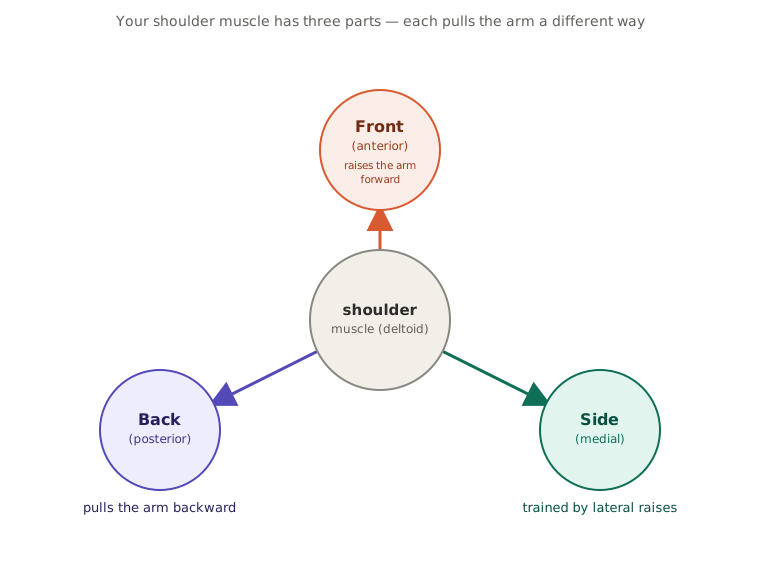
The deltoid isn’t one muscle with one function — it’s three distinct heads that share an origin at the clavicle and acromion but pull in different directions [2]:
| Head | Location | Primary motion | Gets indirect work from pressing? |
|---|---|---|---|
| Anterior (front) | Front of shoulder | Lifts arm forward | Yes — heavily |
| Medial (side) | Top/outer shoulder | Lifts arm out to side | No — almost none |
| Posterior (rear) | Back of shoulder | Pulls arm backward | No — almost none |
The table explains why most home programs produce a muscle imbalance over time: pressing trains the front head well, so it gets strong and developed, while the medial and posterior heads — which need direct isolation work to grow — stay flat. A shoulder that looks wide from the front but flat from the side or back has a training-mix problem, not a volume problem [1][2].
The three exercises below each target exactly one of these heads directly, with the order and volume set to match how much indirect work each head was already getting before the dedicated sets begin.
The workout
Equipment: Two dumbbells — ideally two different weights: a lighter pair for rear delt flies and a slightly heavier pair for lateral raises and front raises. One pair works; just expect to adjust form slightly.
When to do it: At the end of a push session, or as a standalone short workout. Do not do this immediately before heavy overhead pressing — the lateral and posterior heads act as shoulder stabilizers and should not arrive at a heavy pressing movement fatigued.
Frequency: Twice a week, with at least one full rest day between sessions.
Exercise 1 — Lateral raise (medial deltoid)
3 sets × 12–15 reps · 60–90 s rest
The lateral raise goes first because the medial deltoid gets almost no indirect work from pressing and arrives at this session completely fresh — which means concentration and form are at their peak when you need them most for this exercise [1]. A neutral grip (thumbs forward) and a slight forward lean through the scapular plane (roughly 30° forward of directly out to the side) improve isolation over the traditional straight-out raise.
Stop at shoulder height. Raising above it recruits the upper traps, not the medial delt.
Full form breakdown: The Best Side Delt Exercise (And Why Most People Do It Wrong)
Exercise 2 — Rear delt fly (posterior deltoid)
3 sets × 12–15 reps · 60–90 s rest
The rear delt fly follows while concentration is still high, before the accumulated fatigue of a full session degrades the hip-hinge position that makes or breaks this exercise [2]. Hinge forward to roughly 45°, raise the arms out to the sides to shoulder height, and stop. Standing upright turns it into a trap exercise; raising too high does the same.
Use less weight than you expect — the posterior deltoid is a small muscle that responds to control and range of motion, not load.
Full form breakdown: How to Do the Rear Delt Fly (And Fix Flat-Looking Shoulders)
Exercise 3 — Front raise (anterior deltoid)
2 sets × 12–15 reps · 60 s rest
The front raise goes last, with one fewer set than the other two, because the anterior deltoid has already received indirect loading from whatever pressing work preceded this session [1][2]. Its job here is finishing work — controlled isolation at a weight that keeps the torso vertical and the motion in the shoulder, not a momentum exercise. If you find yourself leaning back to raise the weight, the load is too heavy.
Full form breakdown: How to Do the Front Raise (Without Letting Your Back Do the Work)
At a glance
| Exercise | Sets | Reps | Rest | Delt head |
|---|---|---|---|---|
| Lateral raise | 3 | 12–15 | 60–90 s | Medial |
| Rear delt fly | 3 | 12–15 | 60–90 s | Posterior |
| Front raise | 2 | 12–15 | 60 s | Anterior |
Total working sets: 8 · Estimated time: 20–25 min
Who this workout is for
This combination suits anyone training at home with a pair of dumbbells who wants visible shoulder development in all planes — not just a wider front profile from pressing. It works as a standalone session on a day dedicated to smaller muscles, or as a shoulder finisher after a push workout (bench press, overhead press, push-ups).
If you’re new to direct isolation work, the likely surprise is how little weight is needed, especially on the rear delt fly. A 5 kg dumbbell done with a strict hip hinge and controlled tempo trains the posterior deltoid harder than a 12 kg dumbbell bounced through a half-range while standing upright. Choose a weight that makes the last 3–4 reps genuinely hard to complete with good form, not the weight that makes you look like you’re lifting a lot.
Programming notes
Progression: Add weight only when you can complete all reps of a set with clean form. The isolation muscles trained here are small — the lateral and posterior deltoid especially — and fatigue quickly with excess load. Micro-progression (half-kilogram jumps) is appropriate here, not the larger jumps used for compound lifts.
Frequency above twice weekly: A 2019 meta-analysis found that training a muscle at least twice per week produces significantly better hypertrophy than once per week at matched total volume [4]. Three times per week is viable for advanced trainees; for most people, two sessions with good form is the right starting point before adding sessions.
Recovery and protein: Muscle-building from any training — including shoulder isolation — requires adequate protein. Check your daily target with the Protein Intake Calculator if you’re unsure whether you’re eating enough to support the work.
Frequently asked questions
How heavy should the dumbbells be for this shoulder workout?
Different for each exercise. Lateral raises and rear delt flies need a noticeably lighter dumbbell than most people expect — these are small isolation muscles, and a load that produces strict reps without momentum is the right starting point. Front raises can typically use a similar or slightly heavier weight than rear delt flies. A common beginner mistake is matching the weight across all three exercises; the movement that allows the most weight is almost always the one being performed with the most momentum.
Can I do this shoulder workout every day?
No. Isolation work for small muscles like the deltoids still creates muscular stress that needs recovery time. Two to three sessions per week with at least one rest day between them is the right range for most people. Training these muscles daily without adequate recovery produces fatigue without additional growth stimulus.
Do I need a bench for this workout?
No — all three exercises can be done standing. The rear delt fly is the one most often shown seated or with a bench support, but it works equally well standing with a hip hinge. Equipment needed is just a pair of dumbbells and enough floor space to extend your arms.
How long does this workout take?
Around 20–25 minutes including rest intervals. Eight sets total with 60–90 seconds rest between sets works out to roughly 15 minutes of active rest, plus 3–4 minutes of actual lifting time per circuit. It's designed to be a complete shoulder finisher after a push session, or a standalone short workout on a training day focused on smaller muscles.
Why is the front raise programmed last?
Because the anterior deltoid already gets significant indirect work from every pressing movement — bench press, overhead press, push-up. Doing front raises last acknowledges that this head arrives at the shoulder workout pre-fatigued, while the lateral and posterior heads arrive fresh because pressing barely loads them. Starting with the heads that need the most direct work is a better allocation of concentration and energy.
Can this replace a gym shoulder workout?
For most goals, yes. The 2025 dumbbell-vs-cable trial found no meaningful difference in lateral deltoid growth between dumbbells and cables, and the other two exercises (front raise, rear delt fly) are just as effective at home as in a gym setting. The main thing a gym adds is machine variety and incremental weight jumps, but neither is necessary for visible shoulder development.
Sources
- Coratella G, Tornatore G, Longo S, Esposito F, Ce E. Front raise, lateral raise, or overhead press? A study on the effects of grip and shoulder rotation on deltoid activation in resistance-trained individuals. International Journal of Environmental Research and Public Health. 2020;17(17):6015. ↗
- Activation of the three deltoid muscle portions during common strengthening exercises: a systematic review. Journal of Bodywork and Movement Therapies. 2024. ↗
- Larsen S, Wolf M, et al. Dumbbell versus cable lateral raises for lateral deltoid hypertrophy: an experimental study. Frontiers in Physiology. 2025;16:1611468. ↗
- Schoenfeld BJ, Grgic J, Krieger J. How many times per week should a muscle be trained to maximize muscle hypertrophy? Journal of Sports Sciences. 2019;37(11):1286-1295. ↗