How to Do the Front Raise (Without Letting Your Back Do the Work)

 Technical accuracy reviewed by Sophie Laurent
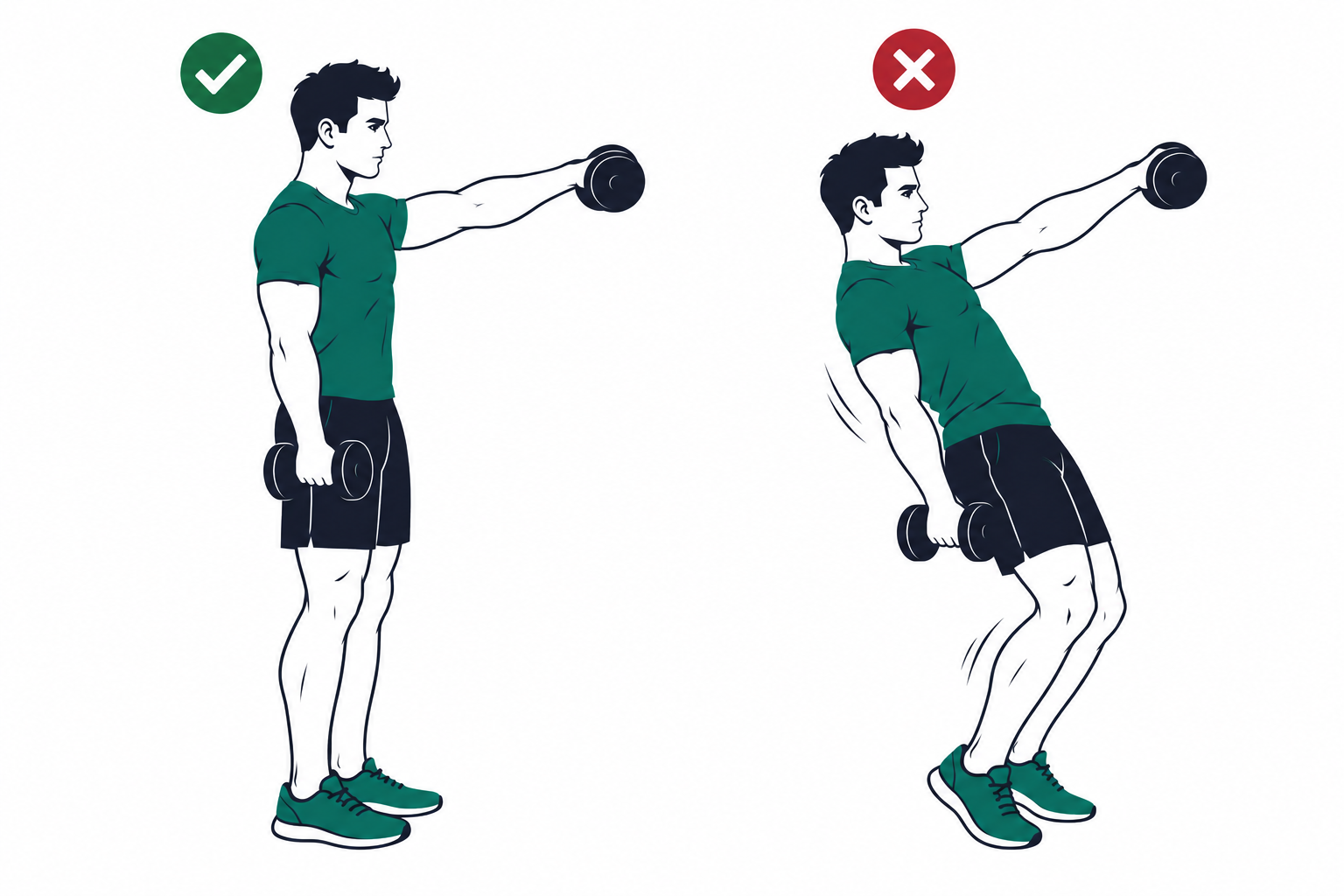
 The front raise looks like the easiest shoulder exercise to get right — lift the weight straight out in front of you — which is exactly why it’s one of the most commonly turned into a momentum exercise. A small backward lean of the torso and a little knee bounce can move almost the entire weight for you, so the exercise gets performed for months with a weight that keeps going up while the shoulder barely does any of the actual lifting.
What the front raise actually trains
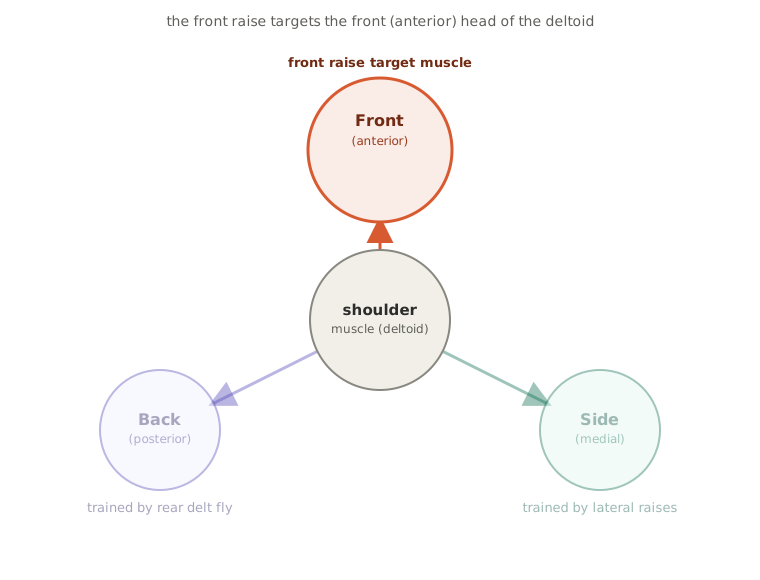
The anterior (front) head of the deltoid lifts the arm forward and upward — the motion trained directly by the front raise, and the same head that gets heavy secondary work from every pressing exercise (bench press, overhead press, push-ups) because pressing always involves some forward arm movement. That overlap is the front raise’s defining feature: unlike the lateral raise or rear delt fly, which train heads that get little indirect work elsewhere, the anterior deltoid usually isn’t the weak link in a shoulder routine — which is exactly why it needs the least weight and the most control, not the most [1].
This is also why front raise is the easiest of the three deltoid exercises to turn into a “how much can I move” contest instead of a muscle-building one: because the anterior deltoid is already well-trained by pressing, people are often stronger here than their strict, momentum-free capacity would suggest, and the gap between the two gets filled with body swing.
How to do it correctly
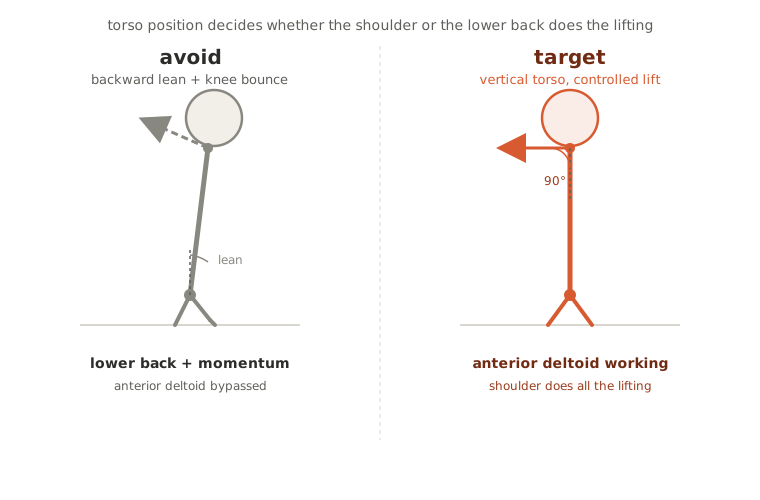
- Keep the torso vertical, no backward lean. Leaning back at the hips as the weight rises is the single most common cheat — it uses gravity and the lower back to help lift the weight instead of the shoulder. Brace your core and keep your ribcage stacked over your hips throughout.
- Raise to shoulder height, not higher. Stopping at shoulder height (arm parallel to the floor) keeps tension on the anterior deltoid; continuing upward shifts the work to the upper traps, which are already well-developed from other lifts.
- Use a controlled tempo, no bounce at the bottom. A quick rebound off the bottom position turns the rep into momentum. Pause briefly at the bottom and lift with a steady, even speed.
- Pick a grip and keep it slightly pronated or neutral. A fully palms-down grip can pinch the shoulder joint at the top for some lifters; a slight neutral angle (thumbs rotated up a few degrees) is usually more comfortable without changing the muscle worked.
- Alternate arms if momentum is a persistent problem. Raising one arm at a time, with the other hand braced on a surface, makes it mechanically harder to cheat with torso lean than raising both arms together.
- Choose a genuinely light weight. Because the anterior deltoid is already pre-fatigued by pressing work, most people need a noticeably lighter dumbbell here than their shoulder press weight would suggest — strict form at a lighter weight beats swung reps at a heavier one every time.
Common mistakes
- Leaning back to help the weight up. This is the dominant form break — it turns the anterior deltoid’s job into a job for the lower back and gravity.
- Raising past shoulder height. Beyond that point, the upper traps take over to finish the range, which is the same failure pattern seen in the rear delt fly when raised too high.
- Using a weight that only works with a knee bounce. If the knees dip and spring at the start of every rep, the weight is too heavy for strict form.
- Programming it as a heavy lift. Because pressing already works the anterior deltoid hard, the front raise is a finishing/isolation movement, not a strength lift — chasing heavy front raise numbers usually just builds a bigger cheat, not a bigger shoulder.
- Ignoring wrist position. Letting the wrist cock back under load shifts strain to the forearm and wrist instead of keeping it in the shoulder — keep the wrist in a neutral line with the forearm.
Programming it alongside your other shoulder work
With the lateral raise and rear delt fly already covering the medial and posterior heads, the front raise completes the set — but it deserves the smallest share of weekly volume of the three, since the anterior deltoid gets so much indirect work from pressing [3]. One to two sets of 12–15 strict reps, once or twice a week, is enough for most people; adding more volume here before confirming your pressing volume is adequate is usually the wrong place to add work. For a ready-made routine that programs all three exercises together in the right order, see the dumbbell shoulder workout at home.
Recovery for this kind of isolation work comes down to overall protein intake as much as programming — check your target with the Protein Intake Calculator if you’re unsure whether you’re eating enough to support training all three heads.
Frequently asked questions
Why does my lower back hurt after front raises?
Almost always a torso-lean issue. If you're leaning backward as the weight rises, your lower back is absorbing load that should stay in the shoulder. Reducing the weight and bracing your core usually resolves it.
Do I need to do front raises if I already do bench press or overhead press?
Often only a little. Pressing movements already give the anterior deltoid substantial indirect work, so front raises are best used as light finishing volume rather than a cornerstone exercise — unlike the lateral raise or rear delt fly, which train heads that get far less indirect work.
How much weight should I use for front raises?
Less than your pressing numbers would suggest. Because the anterior deltoid is already partially fatigued by pressing work, most people need a lighter dumbbell here than they'd guess, especially to avoid leaning back to compensate.
Is the barbell front raise better than the dumbbell version?
Neither is inherently better — the barbell version fixes both hands together, which some people find easier to keep strict, while dumbbells allow a more natural wrist angle and alternating-arm variations. Pick whichever version you can keep strict with the lightest load.
Should I do front raises before or after pressing exercises?
After. Doing front raises first pre-fatigues the anterior deltoid before a heavier pressing movement, which reduces the weight you can safely press. Save isolation work like this for the end of a shoulder or push session.
Can front raises replace shoulder presses?
No — they train the same muscle but can't replicate a press's compound loading or triceps involvement. Think of the front raise as a light accessory to pressing, not a substitute for it.
Sources
- Reinold MM, Macrina LC, Wilk KE, et al. Electromyographic analysis of the supraspinatus and deltoid muscles during 3 common rehabilitation exercises. Journal of Athletic Training. 2007;42(2):223-229. ↗
- Activation of the three deltoid muscle portions during common strengthening exercises: a systematic review. Journal of Bodywork and Movement Therapies. 2024. ↗
- Schoenfeld BJ, Grgic J, Krieger J. How many times per week should a muscle be trained to maximize muscle hypertrophy? Journal of Sports Sciences. 2019;37(11):1286-1295. ↗