How to Do the Rear Delt Fly (And Fix Flat-Looking Shoulders)

 Technical accuracy reviewed by Sophie Laurent
 If your side and front delts have come along fine but your shoulders still look flat when someone sees you from behind, the rear delt fly is usually the missing piece — and usually the most badly executed exercise in a home dumbbell routine. It looks simple: hinge forward, raise the arms out to the sides. In practice, most reps turn into a torso swing that recruits the traps and rear delts almost equally, which is why the exercise gets done for months without the shoulder ever visibly changing.
What the rear delt fly actually trains
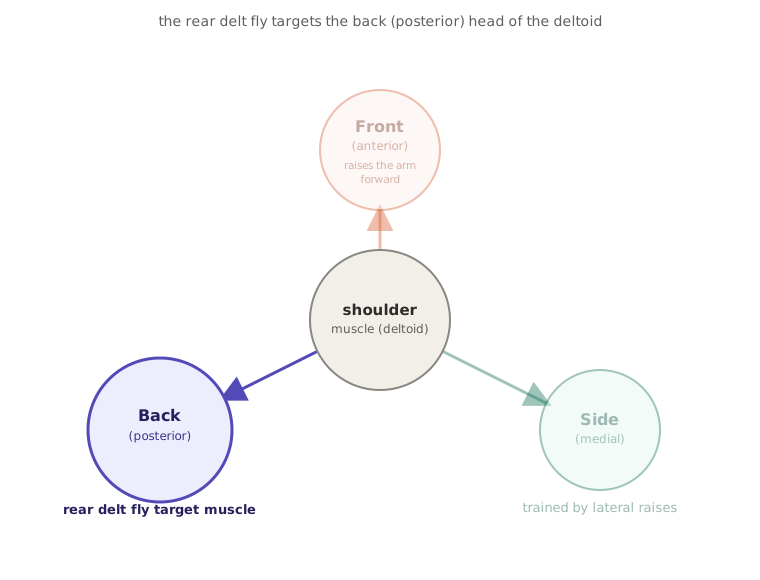
The posterior (rear) head of the deltoid sits at the back of the shoulder and is responsible for horizontal shoulder extension — pulling the upper arm backward when the torso is bent forward, as in a rear delt fly, rather than lifting it upward or outward like the medial head trained by the lateral raise. Of the three deltoid heads, the posterior head is consistently the hardest to isolate, because the middle trapezius and rhomboids sit right behind it and are recruited by almost the same joint action [1][2].
That overlap is why so many people “feel” a rear delt fly in their upper back instead of their shoulder — it isn’t a sign the exercise is broken, it’s a sign the torso angle or the range of motion is letting the bigger, stronger back muscles take over the work the shoulder should be doing.
How to do it correctly
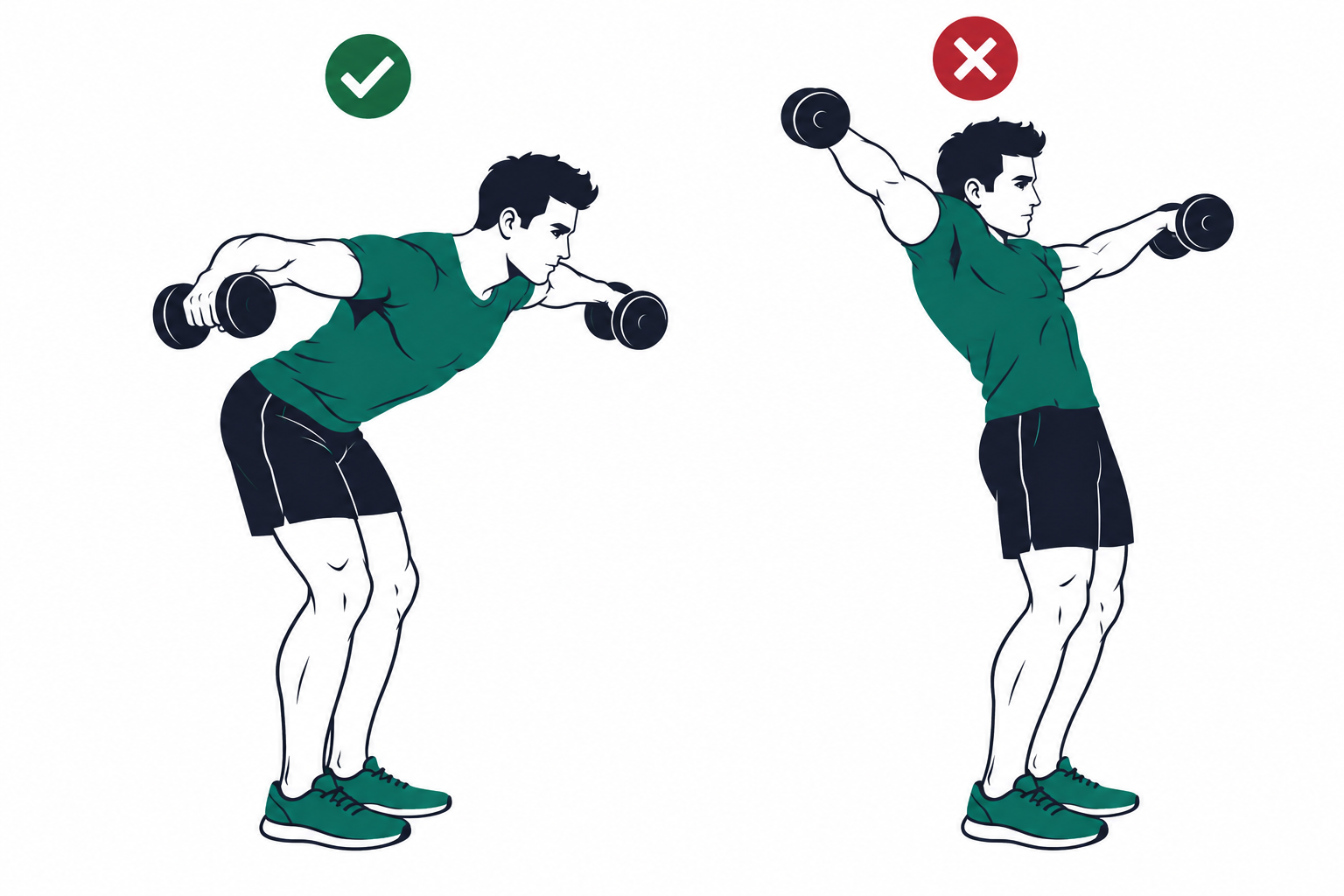
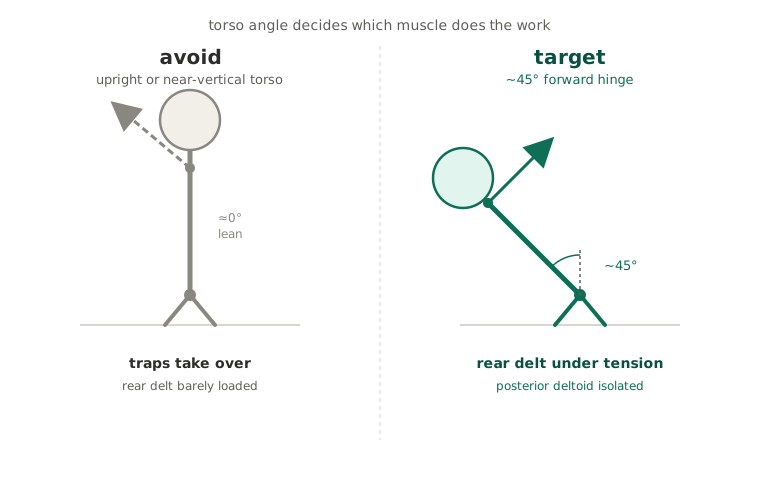
- Hinge your torso to roughly 45°, not upright. Standing near-vertical turns the movement into a lateral raise variant that barely touches the rear delt. Bend from the hips until your chest is angled toward the floor, keeping a flat back — a bench-supported chest-down position removes the temptation to swing entirely and is the better starting regression.
- Start with a soft bend in the elbows and keep it fixed. A locked-straight arm shifts leverage away from the shoulder; a heavily bent elbow turns it into a row. Set a slight, constant elbow bend and hold that angle for the whole set.
- Lead with the elbows, not the hands. Think about lifting your elbows out and slightly back, letting the hands trail. This keeps the motion in the shoulder joint instead of pulling the shoulder blades together first.
- Stop the arms roughly in line with your torso. Raising past shoulder height recruits the upper traps to finish the movement — stop where your upper arm is parallel to the floor.
- Control the lowering phase. A 2–3 second descent keeps tension on the posterior deltoid through the full range; dropping the weight back down removes most of the actual training stimulus.
- Keep the shoulder blades relaxed, not pinched. A deliberate squeeze between the shoulder blades at the top hands the work to the rhomboids and mid-traps — the goal is a shoulder-joint movement, not a scapular-retraction movement.
Common mistakes
- Standing upright instead of hinging. This is the single biggest form break — it turns a rear delt exercise into a lateral raise with worse leverage.
- Using momentum to start the rep. A small torso heave at the bottom lets you use far more weight than your rear delts can actually control, which defeats the point of the exercise.
- Going too heavy to keep strict form. Rear delts are a small muscle group relative to the traps and rhomboids around them — most people need a noticeably lighter dumbbell here than they’d guess, often half of what they use for lateral raises.
- Locking the elbows straight. This shifts the resistance arm and makes the shoulder joint work harder to stabilize than to move, without actually adding rear-delt tension.
- Raising too high. Past shoulder height, the upper traps take over to finish the range — capping the top of the movement at shoulder height keeps the tension where it belongs.
Programming it alongside your other shoulder work
The rear delt fly pairs naturally with the lateral raise to round out shoulder training — most home programs cover the front deltoid indirectly through pressing movements, but the medial and posterior heads need direct, isolated work to develop visibly. Two to three sets of 12–15 controlled reps, two to three times a week, is enough for most people; because the muscle is small and easy to overtrain with sloppy volume, more sets of bad reps will not out-perform fewer sets of controlled ones [3]. For a ready-made session that programs rear delt flies, lateral raises, and front raises in the right order, see the dumbbell shoulder workout at home.
Recovery for a muscle this size and this stimulus-sensitive comes down to consistent protein intake as much as programming — check your target with the Protein Intake Calculator if you’re unsure whether you’re eating enough to support the work.
Frequently asked questions
Why don't I feel the rear delt fly in my shoulders?
Almost always a torso-angle or range-of-motion issue. If you're standing too upright, raising too high, or using momentum, your traps and rhomboids are doing more of the work than your posterior deltoid. Hinge forward to roughly 45° and slow down the movement.
Is the rear delt fly the same as a reverse fly?
Yes — 'rear delt fly,' 'reverse fly,' and 'bent-over reverse fly' all describe the same movement pattern. Some gyms distinguish a machine 'reverse pec deck fly' as a seated variant, but the target muscle and execution cues are the same.
How much weight should I use for rear delt flies?
Less than you'd expect, and usually less than your lateral raise weight. Because the posterior deltoid is a small muscle working from a mechanically weak position, most people need to drop the dumbbell weight noticeably to keep strict form through a full range.
Can I do rear delt flies every day?
No — like any direct isolation work, the posterior deltoid needs recovery time between sessions. Two to three sessions a week with a day of rest in between is a reasonable starting frequency for most people.
Should I do rear delt flies before or after pressing exercises?
Either works, but doing them after your main pressing work means you're not pre-fatiguing a small stabilizing muscle before a heavier compound lift. If shoulder health rather than pure hypertrophy is the goal, some people prefer them as a light activation exercise before pressing instead.
Do rear delt flies help with posture?
They can contribute, since a stronger posterior deltoid supports better shoulder positioning, but posture is driven by several muscle groups together — the mid-traps and rhomboids in particular — so treat this as one part of the picture rather than a posture fix on its own.
Sources
- Reinold MM, Macrina LC, Wilk KE, et al. Electromyographic analysis of the supraspinatus and deltoid muscles during 3 common rehabilitation exercises. Journal of Athletic Training. 2007;42(2):223-229. ↗
- Activation of the three deltoid muscle portions during common strengthening exercises: a systematic review. Journal of Bodywork and Movement Therapies. 2024. ↗
- Schoenfeld BJ, Grgic J, Krieger J. How many times per week should a muscle be trained to maximize muscle hypertrophy? Journal of Sports Sciences. 2019;37(11):1286-1295. ↗