The Best Side Delt Exercise (And Why Most People Do It Wrong)

 Technical accuracy reviewed by Sophie Laurent
 If you’ve been doing lateral raises for months and your shoulders still look narrow, the exercise you picked probably isn’t the problem — how you’re performing it is. Small changes in arm rotation, lean, and tempo separate a set that builds the medial deltoid from one that just tires your traps.
Which exercise actually targets the side delt
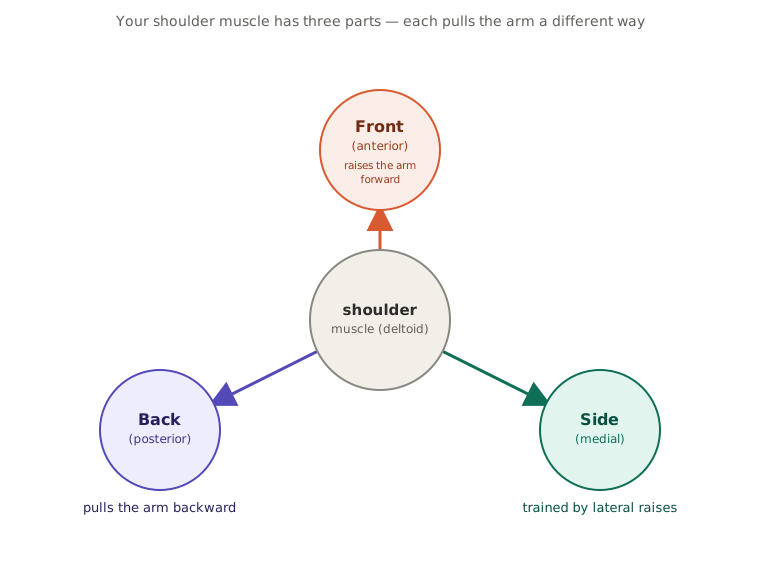
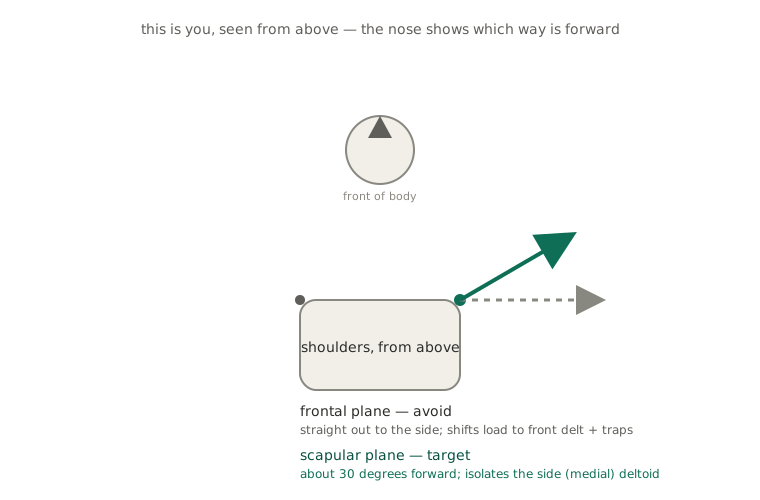
All three deltoid heads — anterior (front), medial/lateral (side), posterior (rear) — share an origin around the shoulder joint but pull in different directions [3], and only a narrow band of movement isolates the medial head specifically: raising the arm out to the side, through the scapular plane (roughly 30° forward of straight out to the side, not directly out to the side), against gravity as the resistance.
That’s the general mechanism behind every “lateral raise” variation — dumbbell, cable, machine, banded. What changes between variations isn’t the muscle being targeted in principle, it’s how consistently the exercise keeps the resistance loading that exact plane through the whole range, and how easy it is to cheat the movement into a different plane once the weight gets heavy.
Two findings from the exercise-science literature are worth building your form around:
- Arm rotation changes which muscle does the work. A 2020 EMG study comparing lateral raise variations in competitive bodybuilders found neutral forearm rotation (thumb pointing forward, not up or down) produced significantly higher medial deltoid activation than an externally rotated variation, a frontal raise, or a flexed-elbow variation — external rotation shifted more work onto the anterior deltoid, and internal rotation shifted it toward the posterior deltoid, traps, and triceps [1]. Neutral is the “side delt” grip; the other two are subtly different exercises wearing the same name.
- Equipment doesn’t matter — cable and dumbbell tie. A 2025 controlled trial found dumbbell and cable lateral raises produced statistically equivalent lateral deltoid hypertrophy over the study period, with the data supporting the null hypothesis (no real difference) rather than a trend either way [2]. If you’re training at home with a single pair of dumbbells, you are not leaving gains on the table versus someone with a cable stack.
Correct form: the neutral-grip lateral raise
- Start position. Stand with a dumbbell in each hand, arms at your sides, a very slight bend in the elbows (locked-straight arms shift stress toward the joint, not the muscle). Hold the dumbbells with a neutral grip — palms facing your body, thumbs forward.
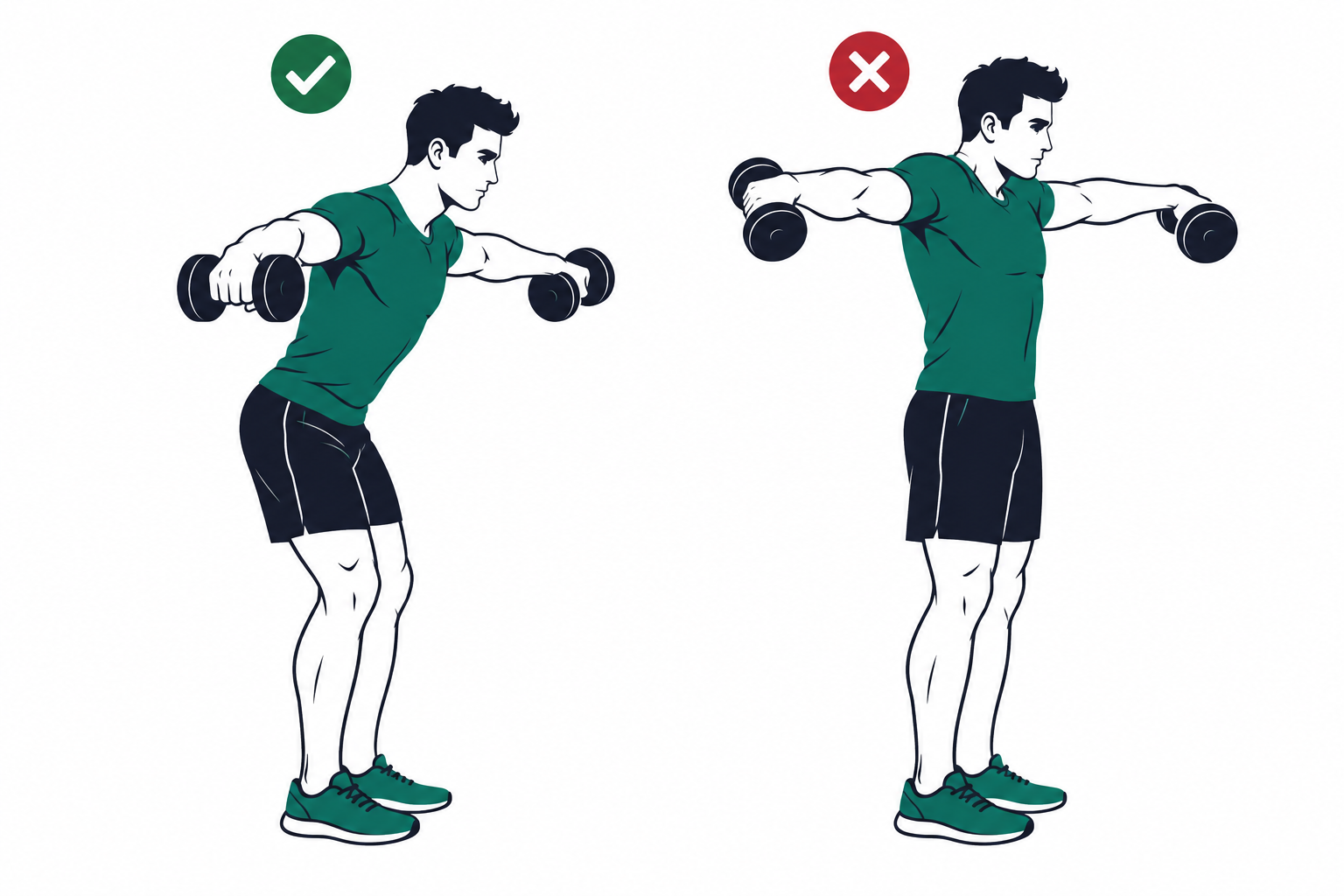
- The lean. Tilt your torso forward from the hips by roughly 20–30°, or let your arms drift slightly in front of the frontal plane as you raise. This is what puts the resistance through the scapular plane instead of straight out to the side — the single biggest form correction most people need.
- The raise. Lift both arms out and slightly forward, leading with your elbows rather than your hands, until they’re roughly parallel to the floor — shoulder height, not higher. Keep the neutral wrist position throughout; don’t let your knuckles rotate upward as you near the top.
- The top. Pause briefly at shoulder height. Going higher than shoulder height recruits the upper traps disproportionately and adds very little medial deltoid stimulus for the risk.
- The lower. Control the descent for 2–3 seconds rather than dropping the weight — the eccentric portion of a lateral raise is where a large share of its hypertrophy stimulus comes from.
- Reps. 10–15 reps per set with strict form, stopping 1–2 reps before you’d need to swing the weight up.
If a cable is available, a cross-body cable lateral raise (cable low, pulling across and up) keeps tension on the medial deltoid at the bottom of the rep, where a dumbbell’s leverage is weakest — a genuinely useful variation to rotate in, not a requirement.
Common mistakes that quietly turn a lateral raise into a shrug
- Raising above shoulder height. This is the single most common form break, and it’s a trap-recruitment problem, not a “more range of motion is always better” situation. Once your arms pass shoulder height, the upper traps take over a growing share of the lift.
- Too much weight, too much momentum. If you need to lean back and heave the dumbbells up with your hips, the weight is too heavy for your medial deltoids specifically, even if it isn’t too heavy for your body as a whole. Drop the load until you can complete the set without body English.
- Wrong plane of motion. Raising directly out to the side (frontal plane) instead of slightly forward (scapular plane) is a smaller-looking error that has a real mechanical cost — it moves the load away from the medial deltoid’s strongest line of pull and toward the front delt and traps picking up the slack.
- Internally rotated (“thumbs down”) execution. Popularized as a way to “feel it more,” this grip measurably shifts activation toward the posterior deltoid, traps, and triceps rather than increasing medial deltoid work [1] — the opposite of what most people doing it intend.
- Locked-out elbows. A rigid, fully extended arm concentrates stress at the elbow joint and makes the whole movement harder to control through a full range; a soft bend keeps the tension on the muscle.
Programming for side delt growth: sets, reps, frequency
Once form is correct, growth becomes a volume-and-consistency question, not a technique question. Two things matter more than exercise selection at this point:
- Frequency. A systematic review and meta-analysis of resistance-training frequency found training a muscle at least twice per week produced greater hypertrophy than training it once per week at the same total weekly volume [4] — splitting your side delt sets across two sessions beats stacking them all into one.
- Total weekly sets. Because the medial deltoid is a small muscle worked directly by an isolation movement, it tolerates and generally responds to a moderate-to-high weekly set count — most lifters see continued progress training it in roughly the low-to-high teens of hard sets per week, spread across at least two sessions, before returns flatten out. Track your own sets over 6–8 weeks and adjust from there rather than assuming a single fixed number applies to you.
Recovery matters as much as volume here: medial deltoids get indirect work from pressing movements too, so if your shoulders feel persistently fried, that’s a signal to look at total weekly shoulder volume across your whole program, not just your dedicated raise sets. For a structured routine that slots lateral raises alongside the front raise and rear delt fly, see the dumbbell shoulder workout at home.
Fuel the growth, not just the lift
Form and programming get the stimulus right — what you eat determines whether your body actually builds new muscle tissue from it. If you’re training side delts specifically to add shoulder width, that’s a muscle-gain goal, and muscle-gain goals have a protein floor that a lot of home-trained lifters undershoot without realizing it. Run your numbers through the Protein Intake Calculator to see your daily target for your bodyweight and training goal — it takes under a minute and removes the guesswork from the other half of the equation.
Frequently asked questions
What is the best exercise for side delts?
The neutral-grip lateral raise, performed with a slight forward lean through the scapular plane rather than straight out to the side. The exercise name matters less than the execution details — arm rotation and plane of motion are what separate an effective set from an ineffective one.
Are cable lateral raises better than dumbbell lateral raises?
No — a controlled 2025 trial found the two produce statistically equivalent lateral deltoid growth. Use whichever you have access to; a cable does offer more consistent tension at the bottom of the rep, which can be a useful variation to include, not a required upgrade.
Why don't I feel my side delts working during lateral raises?
Most commonly because the weight is too heavy and momentum is doing the work, the arms are raising above shoulder height and recruiting the traps, or the raise is happening in the frontal plane instead of drifting slightly forward into the scapular plane. Reducing the weight and correcting the plane of motion usually restores the feeling within a session or two.
How many sets of lateral raises should I do per week?
Spread your side delt sets across at least two sessions a week rather than doing them all in one workout — frequency of at least twice weekly outperforms once-weekly training at matched volume. Most lifters respond well to a moderate-to-high weekly set count for this muscle; track your own results over 6-8 weeks to find your number.
Is the thumbs-down lateral raise better for side delts?
No — despite the popular cue to feel it more, an internally rotated (thumbs-down) grip shifts activation toward the posterior deltoid, upper traps, and triceps rather than increasing medial deltoid recruitment. A neutral grip (thumbs forward) is the better default.
Can I build side delts with dumbbells only, no gym?
Yes. The 2025 dumbbell-vs-cable trial found no meaningful difference in outcomes between the two, and the neutral-grip lateral raise requires nothing beyond a pair of dumbbells and enough room to stand with your arms extended.
Sources
- Coratella G, Tornatore G, Longo S, Esposito F, Ce E. Front raise, lateral raise, or overhead press? A study on the effects of grip and shoulder rotation on deltoid activation in resistance-trained individuals. International Journal of Environmental Research and Public Health. 2020;17(17):6015. ↗
- Larsen S, Wolf M, et al. Dumbbell versus cable lateral raises for lateral deltoid hypertrophy: an experimental study. Frontiers in Physiology. 2025;16:1611468. ↗
- Activation of the three deltoid muscle portions during common strengthening exercises: a systematic review. Journal of Bodywork and Movement Therapies. 2024. ↗
- Schoenfeld BJ, Grgic J, Krieger J. How many times per week should a muscle be trained to maximize muscle hypertrophy? Journal of Sports Sciences. 2019;37(11):1286-1295. ↗