Dumbbell Chest Workout at Home (No Bench Needed)

 Technical accuracy reviewed by Sophie Laurent
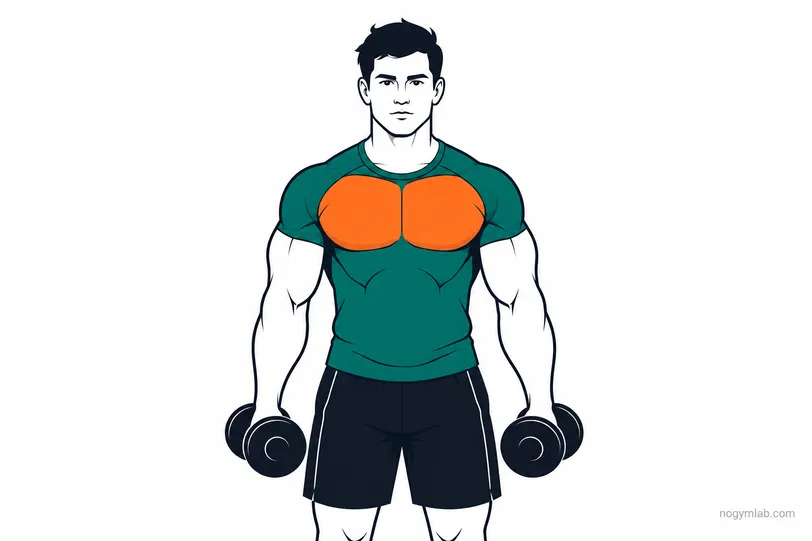
You do not need a bench, a barbell, or a gym to give your chest a proper session. A pair of dumbbells and a patch of floor cover the two jobs the chest does — pressing the arm forward and pulling it across the body — and a few push-up variations fill in the rest.
This article puts those pieces into one workout, with sets and reps for your goal, a sample 3-day split, and a way to progress.
What a chest workout has to cover
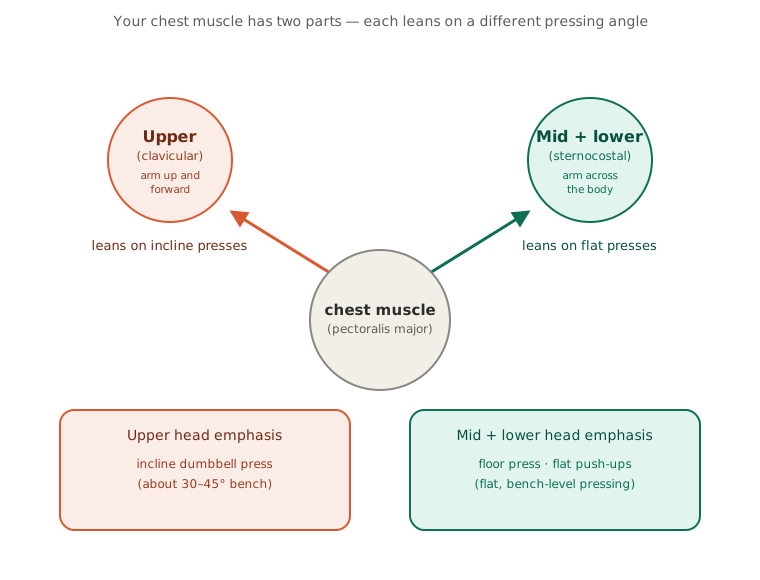
The chest muscle (pectoralis major) is one muscle with two main parts. The upper, clavicular head and the middle-to-lower, sternocostal head are activated to different degrees as the angle of a press changes: in a bench-angle study, the upper head worked harder at inclines and the sternocostal head worked hardest on the flat bench [8]. That is the case for a session that includes a flat-style press and, if you have a bench, an incline press.
The four moves below each have their own page with form detail:
| Move | What it does | Needs a bench? | Full guide |
|---|---|---|---|
| Dumbbell floor press | Flat pressing pattern, elbows stop on the floor | No | Dumbbell floor press |
| Dumbbell chest fly | Arm-across-the-body pattern, lighter loads | No (floor fly) | Dumbbell chest fly |
| Incline dumbbell press | Press at roughly 30–45° | Yes | Incline dumbbell press |
| Push-up variations | Bodyweight press you can scale up or down | No | Push-up variations |
No-bench versions
If all you own is dumbbells, build the session like this:
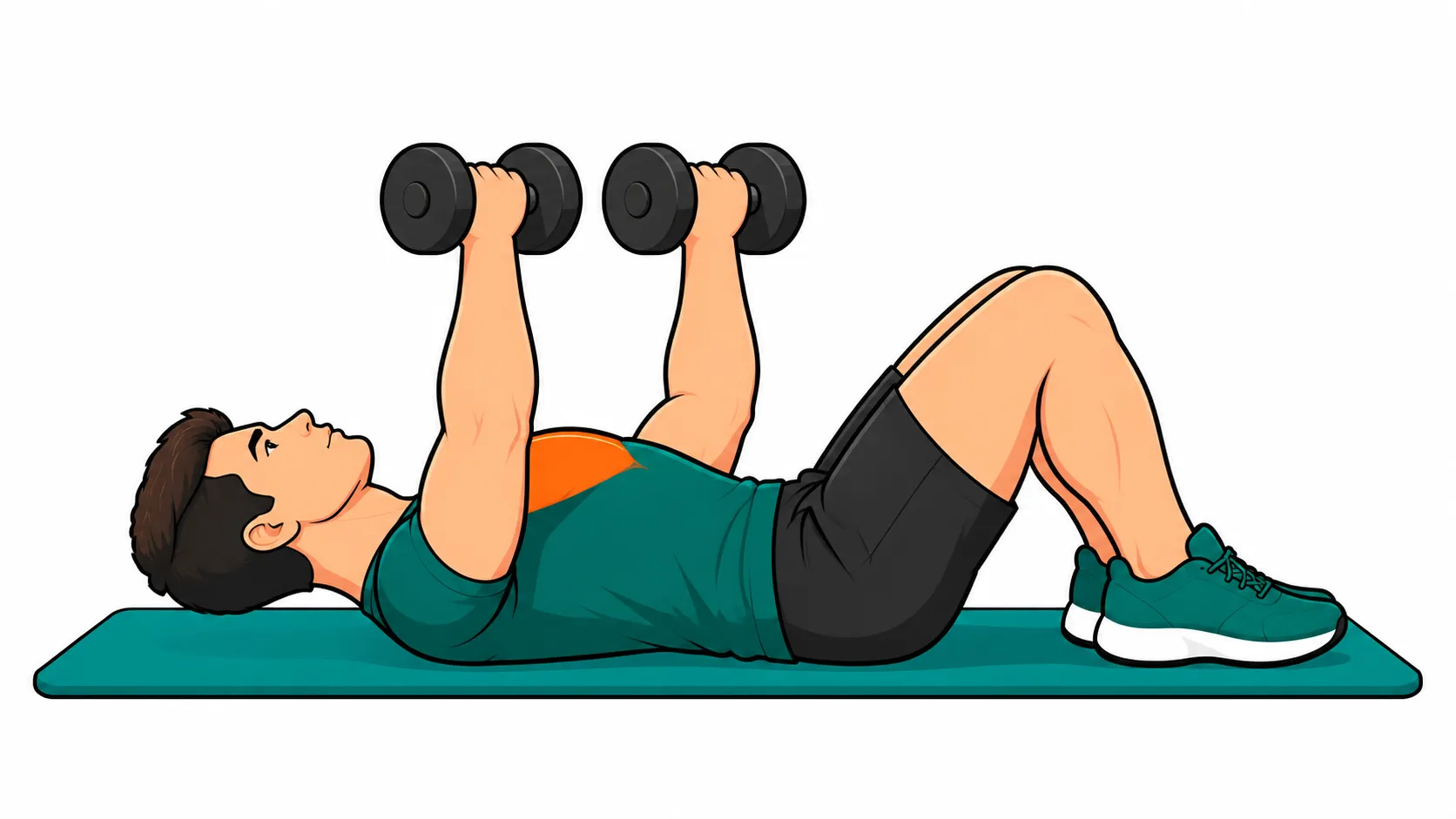
- Floor press instead of bench press. Lie on the floor, press, and let your upper arms touch down each rep.
- Floor fly instead of bench fly. The floor ends the range for you.
- Push-up as the bodyweight press, scaled with hands raised, knees, or feet raised.
- Skip the incline until you have a bench or an adjustable incline. Do not stack unstable furniture under a loaded press.
Dumbbells are a fine tool here: an EMG comparison found the dumbbell bench press and barbell bench press activated the chest and front shoulder to a similar degree, so lifters can use them interchangeably [6].
Sets and reps by goal
The evidence on loading is more forgiving than gym lore suggests. A meta-analysis of 21 studies found heavy loads produced greater maximal strength gains, while muscle growth was similar across light and heavy loads [2]. The 2026 ACSM position stand adds that strength was enhanced by heavier loads (80% of one rep max or more) and 2–3 sets, while growth was enhanced by higher volumes of about 10 or more sets per week [3].
| Goal | Load and reps per set | Sets per exercise | Rest (starting point) |
|---|---|---|---|
| Strength | Heavy, about 5–8 reps | 3 | 2–3 min |
| Muscle size | Moderate, about 8–15 reps | 3 | 60–90 s |
| Light dumbbells only | Light, 15–25 reps, hard final reps | 3 | 60–90 s |
Two notes. First, the light-dumbbell row works because growth was similar across loading ranges in trials where sets were taken hard [2]; if your dumbbells are light, make the last reps of every set properly difficult. Second, you do not need to grind to complete failure: a meta-analysis found no advantage for momentary failure over stopping short of it for growth [4]. Leaving a rep or two in reserve is plenty.
Weekly volume is the lever to watch. A dose-response meta-analysis found that more weekly sets were associated with greater gains in muscle size [1], which is why the split below totals 10 chest sets.
A sample 3-day split (chest sessions only)
This is a fragment, not a full program: it shows where the chest work sits. The other days are for whatever else you train (back, legs, shoulders).
| Day | Chest work | Sets × reps |
|---|---|---|
| Day 1 | Dumbbell floor press | 3 × 6–10 |
| Floor fly | 2 × 10–15 | |
| Day 2 | Other muscle groups; no chest work | — |
| Day 3 | Incline dumbbell press (or push-up variation if no bench) | 3 × 8–12 |
| Push-up variation, a step you can do for 8–12 clean reps | 2 × near your limit |
That is 10 hard sets per week across two chest sessions. A meta-analysis found no significant difference between training frequencies once weekly volume is matched, so two sessions is a convenience, not a rule [5]. If your shoulders are also on the plan, slot the dumbbell shoulder workout at home on a separate day or after the chest work, because pressing already loads the front of the shoulder.
Progression: how to make it harder
Use double progression. Pick a rep range for each exercise (say 8–12), stay at one dumbbell weight, and add reps until every set reaches the top of the range. Then move up in weight and start the range over. Because dumbbells jump in big steps, the one rep max calculator runs the double-progression rule on the dumbbells you actually own and flags a jump that is too big before you make it. To choose a starting load without testing your max, see how 1RM percentages work.
For push-ups, progress by changing the body angle (hands raised → knees → standard → feet raised) before you add anything else. The push-up variations guide covers the ladder.
Log every session: the weight, the reps, and what the last rep felt like. Progress you can see on paper is the easiest way to know the plan is working.
Fuel and recovery
Training gives the signal; food supplies the material. If you are eating to build muscle, keep an eye on your protein with the Protein Tracker, which logs foods against your daily target without an account.
Related guides
Each move above has a full form guide: the dumbbell chest fly, the dumbbell floor press, the incline dumbbell press, and push-up variations.
Frequently asked questions
Can you build your chest with just dumbbells?
Yes. A meta-analysis of 21 studies found muscle growth was similar whether people trained with lighter or heavier loads, so long as the sets were hard [2], and an EMG study found the dumbbell bench press and the barbell bench press activated the pectoralis major to a similar degree [6]. What you need is enough hard sets across the week, not a barbell.
How can I do a chest workout at home without a bench?
Use the floor. The dumbbell floor press covers the pressing pattern, a floor fly covers the arm-across-the-body pattern (the floor stops your elbows), and push-up variations need nothing at all. The incline press is the one move that really needs a bench or adjustable incline.
How many sets of chest per week do I need?
The 2026 ACSM position stand found muscle growth was enhanced by higher volumes, around 10 or more sets per week [3], and a dose-response meta-analysis found more weekly sets were linked with more growth [1]. The sample split below lands on 10 chest sets a week, a sensible place to start before adding more.
How many days a week should I train chest with dumbbells?
Two sessions suits most people. A meta-analysis found no meaningful difference between training frequencies when weekly volume is matched, so you can pick the schedule you will actually keep [5].
How heavy should my dumbbells be for a chest workout?
Heavy enough that the last reps of each set are hard with clean form. Growth was similar across a wide span of loads in the evidence [2], so a pair you can press for roughly 8 to 15 reps works well. For maximal strength, heavier loads (about 80% of your one rep max or more) are the better fit [3].
Do I have to train my chest to failure?
No. A meta-analysis found no advantage for training to momentary failure over stopping short of it for muscle growth [4]. Finishing a set with a rep or two in reserve is enough for most people, and it keeps form cleaner.
Are push-ups enough for a chest workout at home?
They can be a main exercise. In an 8-week trial of 18 men, push-ups matched to 40% of bench-press one rep max produced chest-muscle thickness and strength gains comparable to a bench press at the same load [7]. Once standard push-ups get easy, add a dumbbell press and fly so you can keep loading the muscle.
Should I use both flat and incline presses for my chest?
An EMG study comparing bench angles concluded that doing both flat and incline pressing is needed to recruit the chest muscle fully, because the upper (clavicular) and middle-lower (sternocostal) heads were activated differently at different angles [8].
Sources
- Schoenfeld BJ, Ogborn D, Krieger JW. Dose-response relationship between weekly resistance training volume and increases in muscle mass: a systematic review and meta-analysis. Journal of Sports Sciences. 2017;35(11):1073-1082. ↗
- Schoenfeld BJ, Grgic J, Ogborn D, Krieger JW. Strength and hypertrophy adaptations between low- vs. high-load resistance training: a systematic review and meta-analysis. Journal of Strength and Conditioning Research. 2017;31(12):3508-3523. ↗
- Currier BS, D'Souza AC, Singh MAF, et al. American College of Sports Medicine position stand. Resistance training prescription for muscle function, hypertrophy, and physical performance in healthy adults: an overview of reviews. Medicine and Science in Sports and Exercise. 2026;58(4):851-872. ↗
- Refalo MC, Helms ER, Trexler ET, Hamilton DL, Fyfe JJ. Influence of resistance training proximity-to-failure on skeletal muscle hypertrophy: a systematic review with meta-analysis. Sports Medicine. 2023;53(3):649-665. ↗
- Schoenfeld BJ, Grgic J, Krieger J. How many times per week should a muscle be trained to maximize muscle hypertrophy? A systematic review and meta-analysis of studies examining the effects of resistance training frequency. Journal of Sports Sciences. 2019;37(11):1286-1295. ↗
- Welsch EA, Bird M, Mayhew JL. Electromyographic activity of the pectoralis major and anterior deltoid muscles during three upper-body lifts. Journal of Strength and Conditioning Research. 2005;19(2):449-452. ↗
- Kikuchi N, Nakazato K. Low-load bench press and push-up induce similar muscle hypertrophy and strength gain. Journal of Exercise Science and Fitness. 2017;15(1):37-42. ↗
- Trebs AA, Brandenburg JP, Pitney WA. An electromyography analysis of 3 muscles surrounding the shoulder joint during the performance of a chest press exercise at several angles. Journal of Strength and Conditioning Research. 2010;24(7):1925-1930. ↗