Push-Up Variations for Chest: Easiest to Hardest

 Technical accuracy reviewed by Sophie Laurent
Push-ups need no equipment, but they are only useful if you pick a version that fits your strength today. A push-up you cannot do cleanly turns into sagging hips and half reps, and one that is too easy stops being a challenge after a few sessions. Changing the angle of your body changes the load, so one movement can be scaled all the way from beginner to hard.
What a push-up trains
A push-up is a flat pressing pattern like the bench press. An EMG study found few differences between push-ups and bench press in the prime-mover muscles, apart from more core activation in the push-up [4]. In an 8-week trial of 18 men, push-ups adjusted to the load of a 40% one-rep-max bench press and the bench press itself produced similar increases in chest-muscle thickness and bench strength [5].
The progression ladder
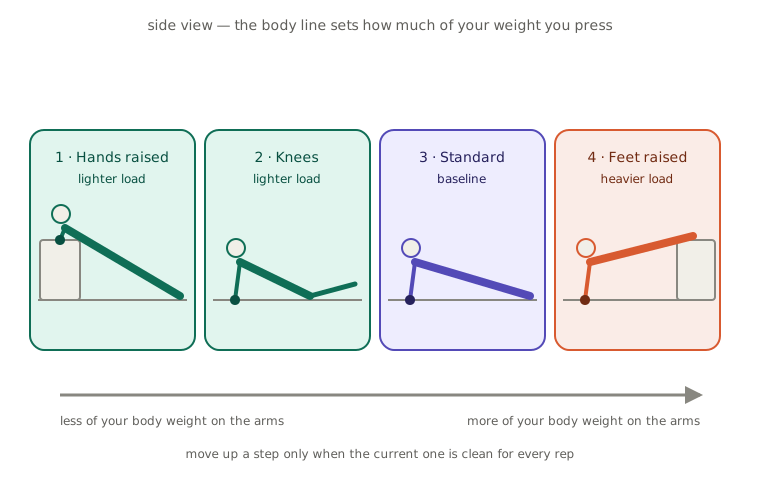
What the force-plate research shows is that body angle sets the load. In a study of 23 people, push-ups with the feet elevated produced a higher ground reaction force than every other variation, while push-ups with the hands elevated and from the knees produced lower force than all the others [1]. Another study measured the initial load relative to body weight at 66.4% for a normal push-up and 52.9% on the knees [2].
Use these steps. The order of the lighter two is not established in the studies (both were lower than the standard push-up), so pick whichever lets you reach 8 to 12 clean reps:
| Step | Variation | Load vs standard | Move on when |
|---|---|---|---|
| 1 | Hands raised (counter, sturdy table, or stairs; lower is harder) | Lower [1] | 12 clean reps for all sets |
| 2 | Knees | Lower [1][2] | 12 clean reps for all sets |
| 3 | Standard push-up | Baseline | 12 clean reps for all sets |
| 4 | Feet raised (low box, then higher) | Higher [1] | Next: add a band or slow the lowering |
| 5 | Resistance band push-up | Higher; activity similar to a heavy bench press [6] | — |
If you have dumbbells and a bench or the floor, the dumbbell floor press is the natural partner when push-ups stop being a challenge.
How to do a standard push-up
- Hands. Place them about shoulder width apart or slightly narrower, under the shoulders, fingers forward.
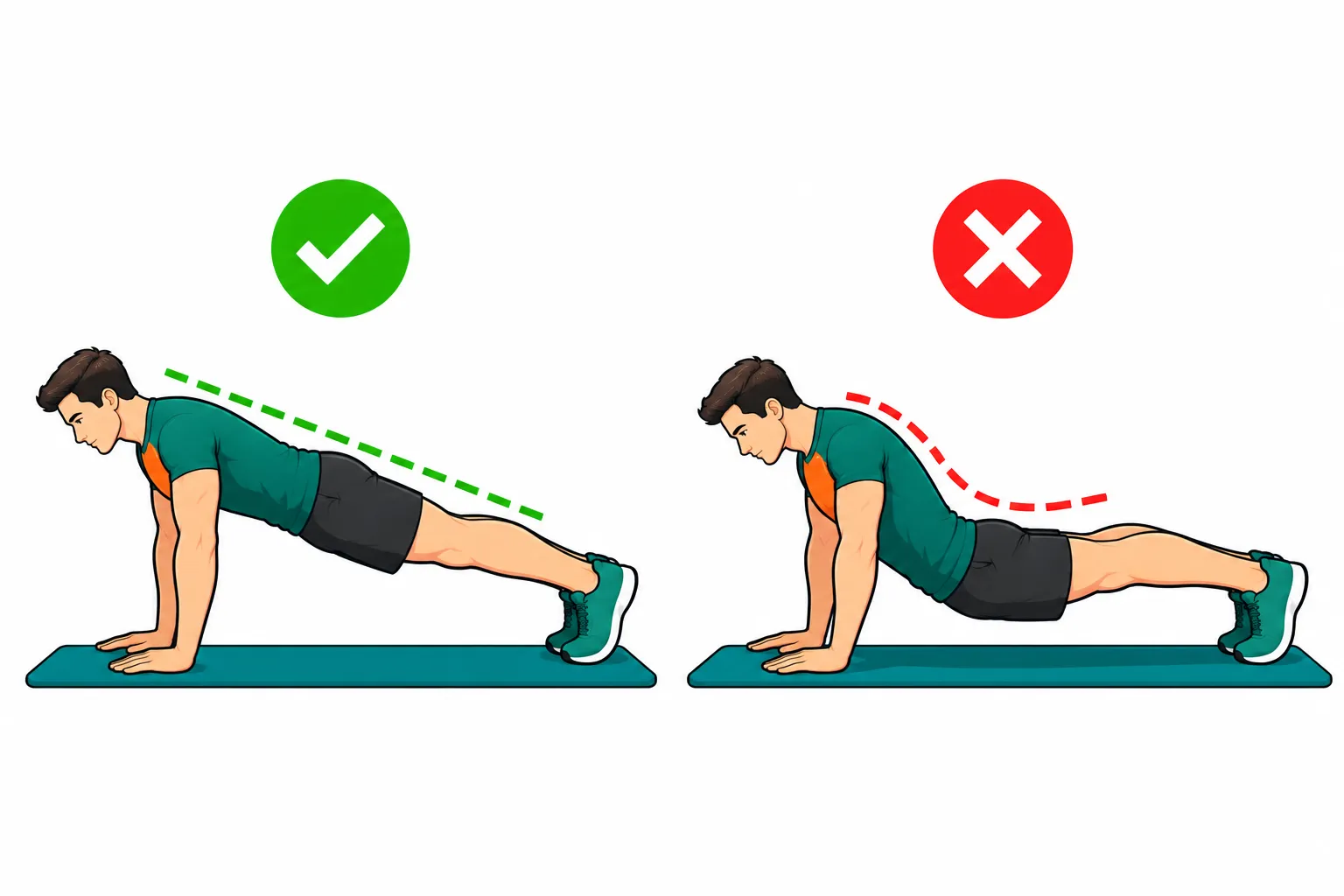
- Body line. Make a straight line from head to heels: glutes and abs braced, hips neither sagging nor piking.
- Lower. Bring your chest toward the floor with your elbows at roughly 45° from your torso, not straight out to the sides. This is a form cue, not a measured optimum.
- Press. Push the floor away until your arms are straight, keeping the same body line.
- Tempo. Take about 2 seconds down and press up at a controlled pace.
Hand position
Two studies found narrow hand placement gave higher chest and triceps activity than a wide placement. One tested 40 people with a shoulder-width, wide, and narrow base [3], and another found narrow hand positions generally gave greater activation [4]. This tells you narrow is harder on those muscles, not that wide is useless; choose a width you can repeat cleanly and vary it between sessions.
Common mistakes
- Sagging hips or a piked bottom. Either one breaks the body line. This is what the red version of the illustration above shows.
- Half reps. Go until your chest is a fist’s width from the floor.
- Flared elbows. Keep them tucked.
- Jumping steps. Move up only when every rep of every set is clean.
- Head dropping forward. Keep your neck in line with your spine.
Programming push-ups
Pick the step where you can do 8 to 12 clean reps, and do 2 to 3 sets near your limit after your main press. To keep growing, add reps first, then move to the next step on the ladder. Count your push-up sets toward the weekly chest total described in the dumbbell chest workout at home. If you are also training shoulders, see the dumbbell shoulder workout at home for how the two fit together, and check your protein with the Protein Intake Calculator if building muscle is the goal.
Frequently asked questions
Which push-up variation is best for the chest?
The one you can do for 8 to 12 clean reps that still feels hard. In an 8-week trial, push-ups adjusted (for example by kneeling) to match 40% of bench-press one rep max built chest-muscle thickness and strength similar to the bench press [5]. Within that, narrow hand positions raised chest and triceps EMG versus wide ones in two studies [3][4].
What push-up variation works the upper chest?
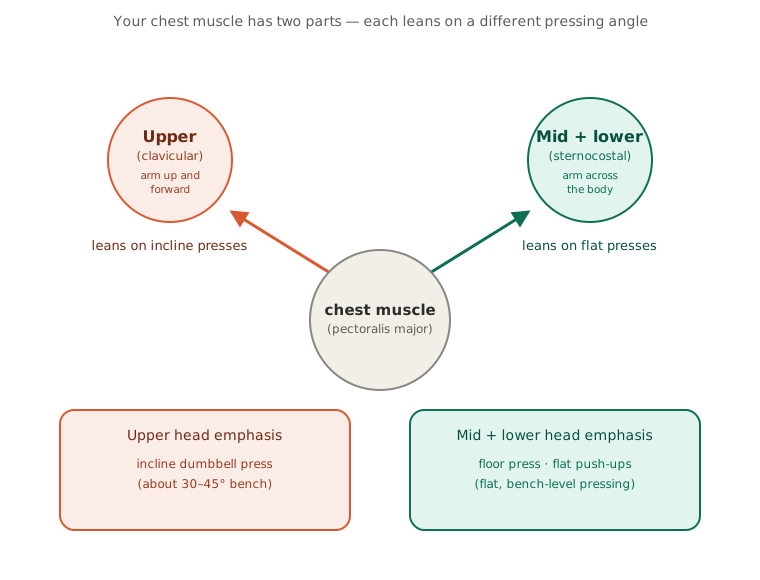
None of the sources used here show a push-up variation that selectively targets the upper chest. The upper-chest evidence is from bench-angle studies; see the incline dumbbell press. Raising your feet changes the load on your arms [1] but was not tested for chest-head activation.
What push-up variation works the lower chest?
There is no verified evidence that a push-up variation selectively targets the lower chest. In bench-angle studies the middle and lower chest worked hardest on flat pressing, which a standard push-up resembles, so a flat push-up is a reasonable choice.
How many push-up variations should I do?
One or two in a session is plenty. Use a variation you can do for 8 to 12 clean reps, take it near your limit, and move to the next step only when every rep is clean. Total weekly chest sets (about 10 or more) matter more than the number of variations.
Which push-up variation is the hardest?
Of the variations measured, feet-raised push-ups produced the highest ground reaction force, meaning the most load on the arms [1]. Adding elastic resistance to a floor push-up also raised muscle activity to levels similar to a heavy bench press [6].
Are push-ups as good as bench press for the chest?
Under matched conditions, yes. In an 8-week study, push-ups matched to 40% of one rep max and a bench press at that load both increased pectoralis major thickness and bench strength [5], and an EMG study found muscle activity patterns did not differ between the two [4].
Are knee push-ups as effective as regular push-ups?
They are lighter. The initial load relative to body weight was 66.4% for a normal push-up and 52.9% on the knees, and muscle activity was lower on the knees in one study [2]. Another study found no significant difference in each muscle's share of the work between toes and knees [4]. Use knees as a step toward the standard push-up.
Do wide or narrow push-ups work the chest more?
Narrow hand positions gave higher chest and triceps EMG than wide ones in two studies [3][4]. Higher EMG is not the same as more growth, so choose a width you can repeat for clean reps and vary it.
Sources
- Ebben WP, Wurm B, VanderZanden TL, Spadavecchia ML, Durocher JJ, Bickham CT, Petushek EJ. Kinetic analysis of several variations of push-ups. Journal of Strength and Conditioning Research. 2011;25(10):2891-2894. ↗
- Gouvali MK, Boudolos K. Dynamic and electromyographical analysis in variants of push-up exercise. Journal of Strength and Conditioning Research. 2005;19(1):146-151. ↗
- Cogley RM, Archambault TA, Fibeger JF, Koverman MM, Youdas JW, Hollman JH. Comparison of muscle activation using various hand positions during the push-up exercise. Journal of Strength and Conditioning Research. 2005;19(3):628-633. ↗
- Gottschall JS, Hastings B, Becker Z. Muscle activity patterns do not differ between push-up and bench press exercises. Journal of Applied Biomechanics. 2018;34(6):442-447. ↗
- Kikuchi N, Nakazato K. Low-load bench press and push-up induce similar muscle hypertrophy and strength gain. Journal of Exercise Science and Fitness. 2017;15(1):37-42. ↗
- Calatayud J, Borreani S, Colado JC, Martin F, Rogers ME. Muscle activity levels in upper-body push exercises with different loads and stability conditions. The Physician and Sportsmedicine. 2014;42(4):106-119. ↗