Dumbbell Floor Press: Form and Floor vs Bench Press

 Technical accuracy reviewed by Sophie Laurent
If you do not own a bench, the dumbbell floor press is the easiest way to get a heavy chest press at home. You lie on the floor, press two dumbbells up, and let your upper arms touch the ground at the bottom of each rep. The floor does two jobs: it replaces the bench, and it gives every rep the same end point.
What the floor press trains
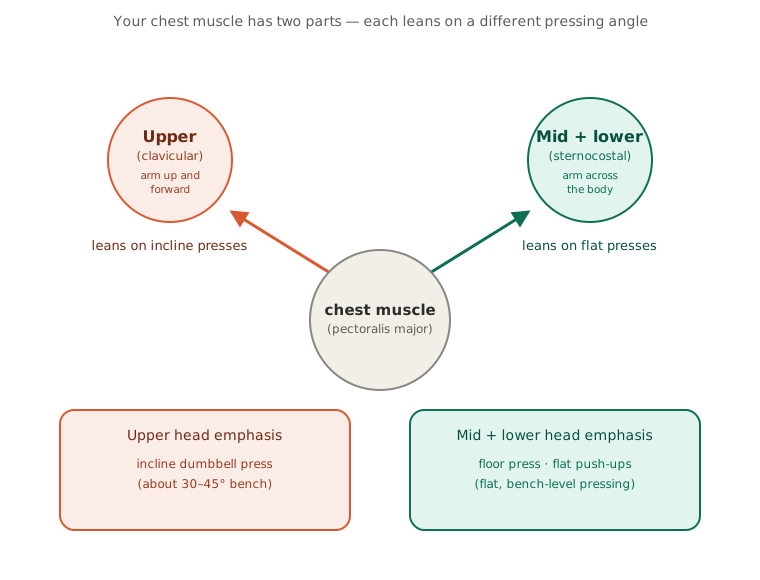
The floor press is a flat pressing pattern. In a bench-angle EMG study of 30 trained adults, the middle and lower portions of the chest showed higher activity at a horizontal (0°) bench, while the upper portion peaked around 30° [2]. A flat-style press therefore leans on the middle and lower chest, with the triceps and front of the shoulder helping.
Dumbbells are a fine way to do it: in an EMG study, the dumbbell bench press and barbell bench press produced similar pectoralis major and anterior deltoid activation, and the authors said they could be used interchangeably [1].
Floor press vs bench press
The main mechanical difference is the bottom of the range. On a bench, the dumbbells can travel below chest level; on the floor, the triceps touch down and stop the movement.
What the evidence says about range of motion is nuanced. A meta-analysis found full range of motion produced greater strength gains than partial range of motion, and no significant difference in muscle thickness between the two [3]. The 2026 ACSM position stand likewise listed a complete range of motion among the factors that enhanced strength [4]. Those reviews pool many exercises and do not test the floor press specifically, so read them as context: use the floor press when you have no bench, and a bench if you have one and want the longer range.
How to do it
- Set up. Sit on the floor with a dumbbell on each thigh, then lie back, using your knees to help swing the dumbbells to your chest. Bend your knees and plant your feet.
- Start position. Hold the dumbbells over your chest with your upper arms resting on the floor and your forearms vertical.
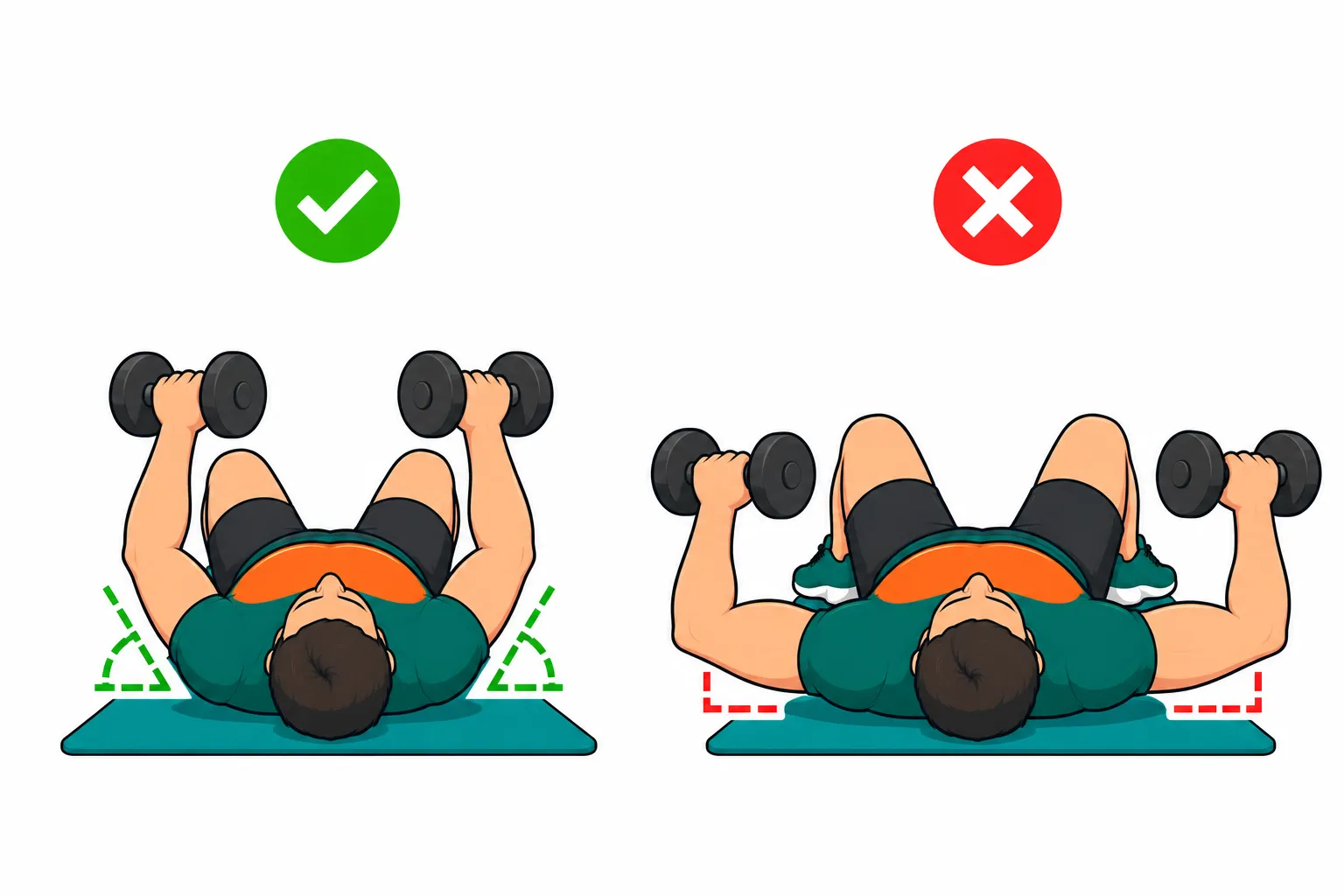
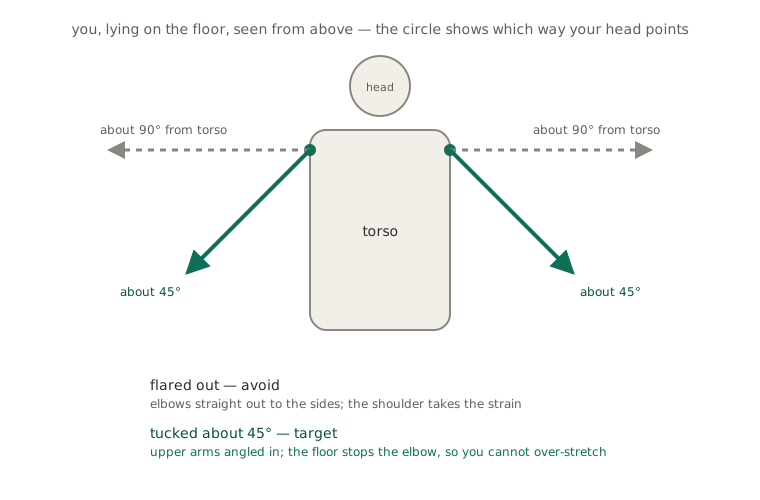
- Tuck the elbows. Aim for your upper arms at roughly 45° from your torso, not straight out to the sides. This is a form cue, not a measured optimum.
- Press. Drive the dumbbells up until your arms are straight but not locked, keeping the forearms vertical.
- Lower with control. Take 2 to 3 seconds and touch the upper arms to the floor lightly. Do not bounce.
- Brace. Keep your lower back and glutes in contact with the floor, and your wrists stacked over your elbows.
Common mistakes
- Flaring the elbows to 90°. Straight-out elbows make the position harder to control. Keep them tucked.
- Bouncing off the floor. The floor is a stop, not a spring.
- Letting the wrists bend back. Stack the wrist over the forearm and elbow.
- Using a weight you cannot get into position. If you cannot lift the dumbbells to your chest and back up safely, drop the weight.
- Lifting the hips. The press should come from the chest, not from arching the back.
Programming the floor press
Use it as your first chest exercise: 3 sets of 6 to 10 reps for strength-leaning work, or 8 to 15 for muscle size, with 2 to 3 minutes of rest for heavy sets. The 2026 ACSM position stand found strength was enhanced by loads of 80% of one rep max or more and 2 to 3 sets, while growth was enhanced by higher weekly volumes (around 10 or more sets per week) [4].
Progress by adding reps first, then weight; the one rep max calculator plans the next dumbbell step. Pair it with the incline dumbbell press if you have a bench, and see the full dumbbell chest workout at home for where it sits in a week. If you are also training shoulders, the dumbbell shoulder workout at home shows how to arrange the two.
Frequently asked questions
Is the dumbbell floor press effective for the chest?
It trains the same flat pressing pattern as a bench press. An EMG study found dumbbell and barbell bench presses activated the pectoralis major to a similar degree [1], and a bench-angle study found flat pressing produced the highest activity in the middle and lower chest [2]. None of the sources used here tested the floor press itself, so those are the closest evidence.
What muscles does the dumbbell floor press work?
The chest (pectoralis major) is the main mover, with the front of the shoulder and the triceps assisting. In a flat press the middle and lower parts of the chest showed the highest activity in one study [2].
Can you do a dumbbell press on the floor?
Yes. Lie on your back with your knees bent and feet flat, hold a dumbbell in each hand at chest level with your upper arms resting on the floor, and press the weights up. Lower until your upper arms touch down.
Is the floor press better than the bench press?
Neither wins outright. The floor shortens the bottom of the range, and a meta-analysis found full range of motion produced greater strength gains than partial range, with no significant difference for muscle thickness [3]. Those reviews are not floor-press specific, so use the floor press when you have no bench and a bench when you do.
Does the dumbbell floor press work upper chest or lower chest?
A flat press leans toward the middle and lower chest, while the upper chest does relatively more as the bench inclines [2]. If upper chest is a priority and you have a bench, add an incline dumbbell press.
Is the dumbbell floor press better than push-ups?
They are different tools. Push-ups use your body weight, which you can scale with body angle; the floor press lets you choose the load in small dumbbell steps. Many people alternate them across the week.
What is a good weight for the dumbbell floor press?
One that lets you finish your target reps with clean form and leaves the last reps hard. ACSM found strength was enhanced by heavier loads (about 80% of one rep max or more) with 2 to 3 sets [4]; for muscle growth, moderate loads taken close to your limit are fine. The one rep max calculator can turn a recent set into a working weight.
Can you do the dumbbell floor press on a bed?
A bed is soft, so the end point of each rep is less consistent. The firm floor is what gives the exercise its fixed stopping point, so use the floor.
Sources
- Welsch EA, Bird M, Mayhew JL. Electromyographic activity of the pectoralis major and anterior deltoid muscles during three upper-body lifts. Journal of Strength and Conditioning Research. 2005;19(2):449-452. ↗
- Rodríguez-Ridao D, Antequera-Vique JA, Martín-Fuentes I, Muyor JM. Effect of five bench inclinations on the electromyographic activity of the pectoralis major, anterior deltoid, and triceps brachii during the bench press exercise. International Journal of Environmental Research and Public Health. 2020;17(19):7339. ↗
- Pallarés JG, Hernández-Belmonte A, Martínez-Cava A, Vetrovsky T, Steffl M, Courel-Ibáñez J. Effects of range of motion on resistance training adaptations: a systematic review and meta-analysis. Scandinavian Journal of Medicine and Science in Sports. 2021;31(10):1866-1881. ↗
- Currier BS, D'Souza AC, Singh MAF, et al. American College of Sports Medicine position stand. Resistance training prescription for muscle function, hypertrophy, and physical performance in healthy adults: an overview of reviews. Medicine and Science in Sports and Exercise. 2026;58(4):851-872. ↗