Dumbbell Chest Fly: Form, Elbow Path, and Fly vs Press

 Technical accuracy reviewed by Sophie Laurent
The dumbbell chest fly looks easy: lie back, open your arms, and bring the weights together. In practice it is the exercise most often done with the elbows sinking low and the arms straightening out, turning a chest movement into a stretch under load that the shoulder has to control. A few details of elbow bend and arm path make the difference.
What the fly trains
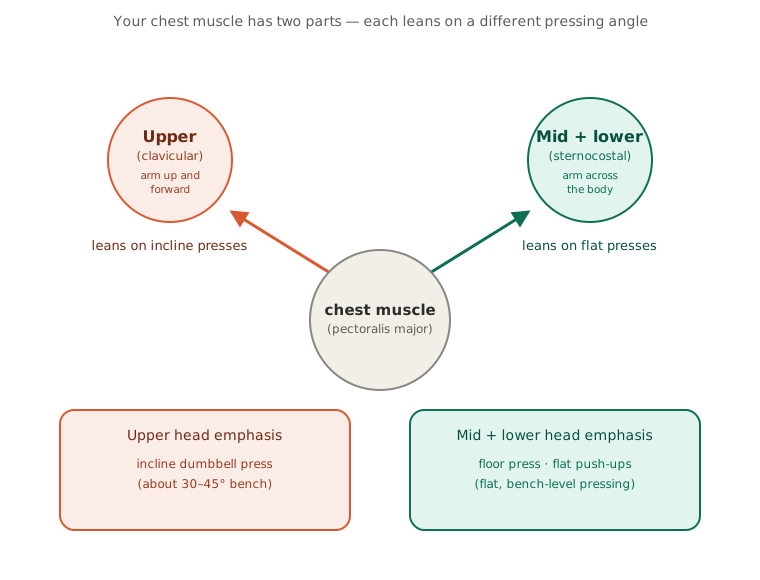
The chest muscle’s job in a fly is horizontal adduction: bringing the upper arm across the body. In an isometric EMG study, the muscle’s segments were controlled independently, and horizontal shoulder flexion drew activity from the middle segments of the muscle regardless of the shoulder flexion angle [2]. Think of the fly as a way to load that arm-across-the-body action directly, with the elbow angle held fixed rather than extending as in a press.
Fly vs press
An EMG study of 12 men and women had them perform a barbell bench press, a dumbbell bench press, and a dumbbell fly using their 6-repetition maximum. Activation of the pectoralis major and anterior deltoid was not significantly different across the three lifts, but the fly had a significantly shorter relative time of activation. The authors concluded that flys may be best as an auxiliary lift, while barbell and dumbbell presses can be used interchangeably [1].
Practically: lead with a press (dumbbell floor press or an incline dumbbell press), and finish with the fly. For the full session plan, see the dumbbell chest workout at home.
How to do it
- Set up. Lie on a bench or the floor with a dumbbell in each hand, palms facing each other, and press them above your chest. Keep your feet planted and your shoulder blades pulled gently back and down against the surface.
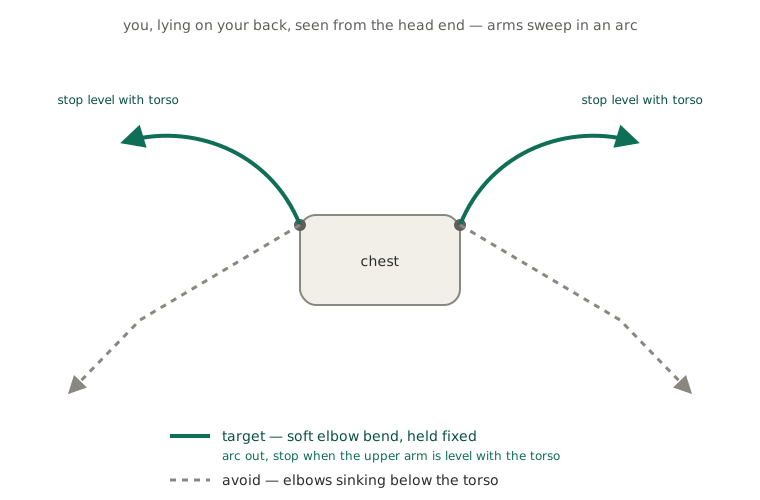
- Fix the elbow bend. Soften your elbows and hold that same angle for the whole set. Do not straighten them on the way down, and do not bend more on the way up (that would turn it into a press).
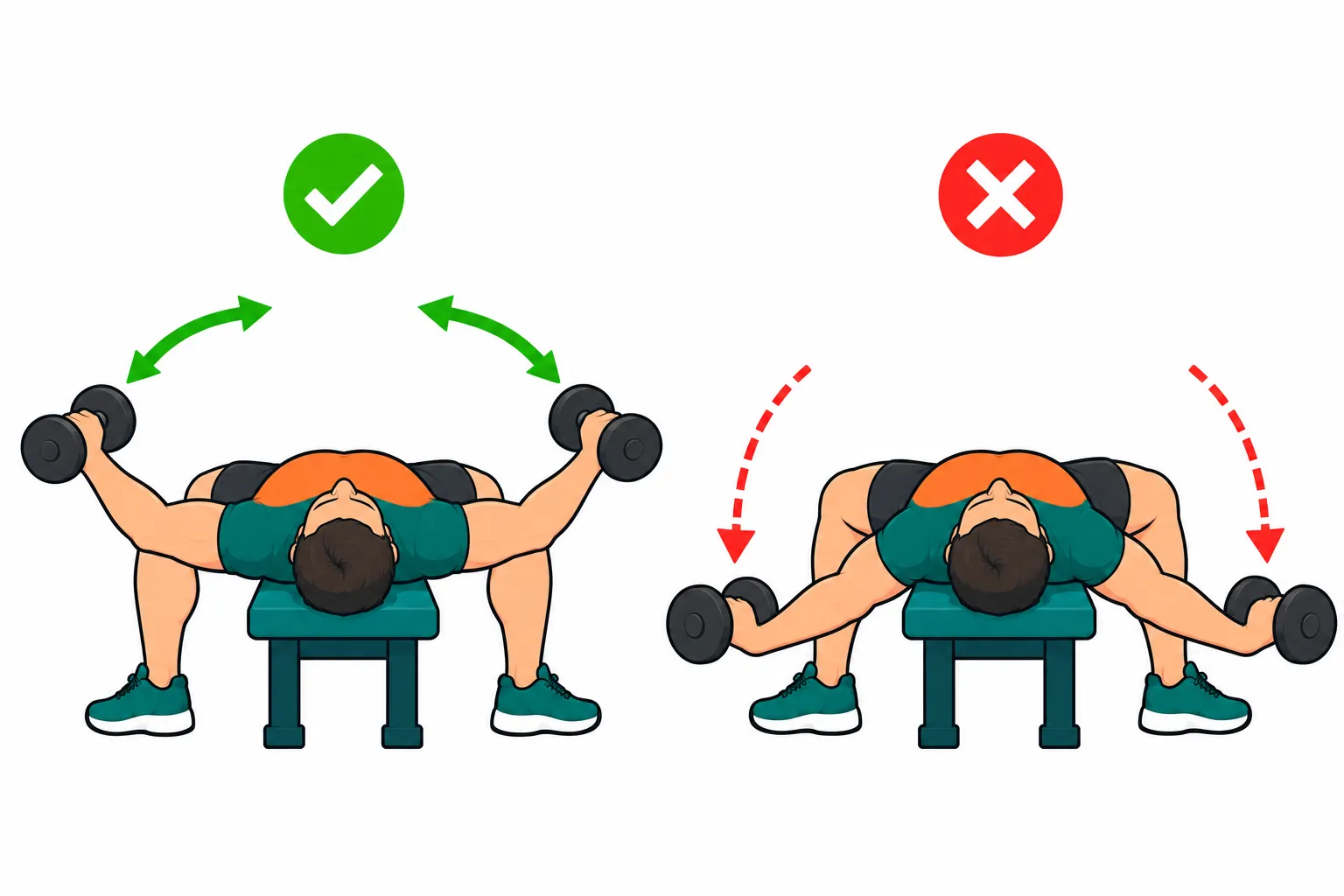
- Arc out. Lower the dumbbells in a wide arc until your upper arms are roughly level with your torso. On the floor, this is where your upper arms touch down.
- Stop there. Going lower than torso level lets the elbows sink and loads the front of the shoulder more than the chest.
- Bring them back. Squeeze the dumbbells back along the same arc, thinking about moving your elbows toward each other rather than lifting your hands.
- Control the lowering. Take about 2 to 3 seconds on the way down. Dropping into the bottom removes the control that makes the exercise work.
Common mistakes
- Elbows sinking below the torso. The arc deepens but the lever arm lengthens, and it becomes a shoulder-stretching exercise you cannot control with light weight.
- Straightening the arms. A locked-out arm makes the dumbbells a long lever. Keep the soft bend.
- Turning it into a press. If your elbows bend more as you lift, the weight is too heavy for a fly. Lower it.
- Bouncing out of the bottom. Use a controlled pause instead.
- Going too heavy. The fly uses much lighter dumbbells than the press. Muscle growth was similar across light and heavy loads in a meta-analysis [3], so there is no need to chase heavy weights here.
Programming the fly
Do 2 to 3 sets of 10 to 15 reps after your main press, close to your limit but with clean form. The 2026 ACSM position stand found muscle growth was enhanced by higher weekly volumes (around 10 or more sets per muscle per week) [4], so count your fly sets toward that total rather than adding them on top of a long list of presses.
Progress with double progression: add reps until all sets reach the top of the range, then step up in weight. The one rep max calculator plans that next dumbbell step for the pairs you own. If you are pairing chest and shoulders in the same week, see the dumbbell shoulder workout at home.
Frequently asked questions
What part of the chest does the dumbbell fly work?
The whole pectoralis major contributes, with the middle part of the muscle most involved when the arm moves across the body. In an isometric EMG study, horizontal shoulder flexion (the fly's arm path) drew activity from the middle segments of the muscle [2]. That study did not test the dumbbell fly itself, so treat it as a guide to the movement, not a promise about one head.
Are dumbbell flys good for the chest?
Yes, as a supporting exercise. In an EMG study the fly activated the pectoralis major as much as the barbell and dumbbell bench press, but for less of each rep [1]. That is why it works best after a press rather than instead of one.
Is the dumbbell chest fly isolation or compound?
Isolation. Only the shoulder joint moves while the elbow angle stays fixed, unlike a press where the elbows also extend. That is also why it takes far lighter dumbbells.
How heavy should I go for dumbbell chest flys?
Lighter than your press. Muscle growth was similar across light and heavy loads in a meta-analysis [3], so pick a dumbbell you can control through the full arc for 10 to 15 reps with the last reps hard.
Can you do a dumbbell chest fly on the floor?
Yes, and it is a good no-bench option. The floor stops your upper arms when they reach torso level, so you cannot sink the elbows too low. See the no-bench options in the dumbbell chest workout at home.
Can you do a dumbbell chest fly standing up?
A standing fly with dumbbells cannot load the chest because gravity pulls straight down while the arm path is across the body, so there is no load at the top of the movement. Use a cable or resistance band for a standing version, or lie down for the dumbbell fly.
Why are dumbbell flys so hard?
The weight sits far from the shoulder joint at the bottom of the arc, so even a light dumbbell creates a lot of leverage on the muscle. That is normal. Drop the weight until you can keep the elbow bend fixed and lower under control.
Is the dumbbell fly better than the dumbbell press?
Not as a first choice. The EMG study found similar activation but less time under activation for the fly [1], and a press lets you load the chest far more heavily. Use the press first, then a fly for 2 to 3 lighter sets.
Sources
- Welsch EA, Bird M, Mayhew JL. Electromyographic activity of the pectoralis major and anterior deltoid muscles during three upper-body lifts. Journal of Strength and Conditioning Research. 2005;19(2):449-452. ↗
- Paton ME, Brown JM. An electromyographic analysis of functional differentiation in human pectoralis major muscle. Journal of Electromyography and Kinesiology. 1994;4(3):161-169. ↗
- Schoenfeld BJ, Grgic J, Ogborn D, Krieger JW. Strength and hypertrophy adaptations between low- vs. high-load resistance training: a systematic review and meta-analysis. Journal of Strength and Conditioning Research. 2017;31(12):3508-3523. ↗
- Currier BS, D'Souza AC, Singh MAF, et al. American College of Sports Medicine position stand. Resistance training prescription for muscle function, hypertrophy, and physical performance in healthy adults: an overview of reviews. Medicine and Science in Sports and Exercise. 2026;58(4):851-872. ↗