Incline Dumbbell Press: Best Angle for Upper Chest

 Technical accuracy reviewed by Sophie Laurent
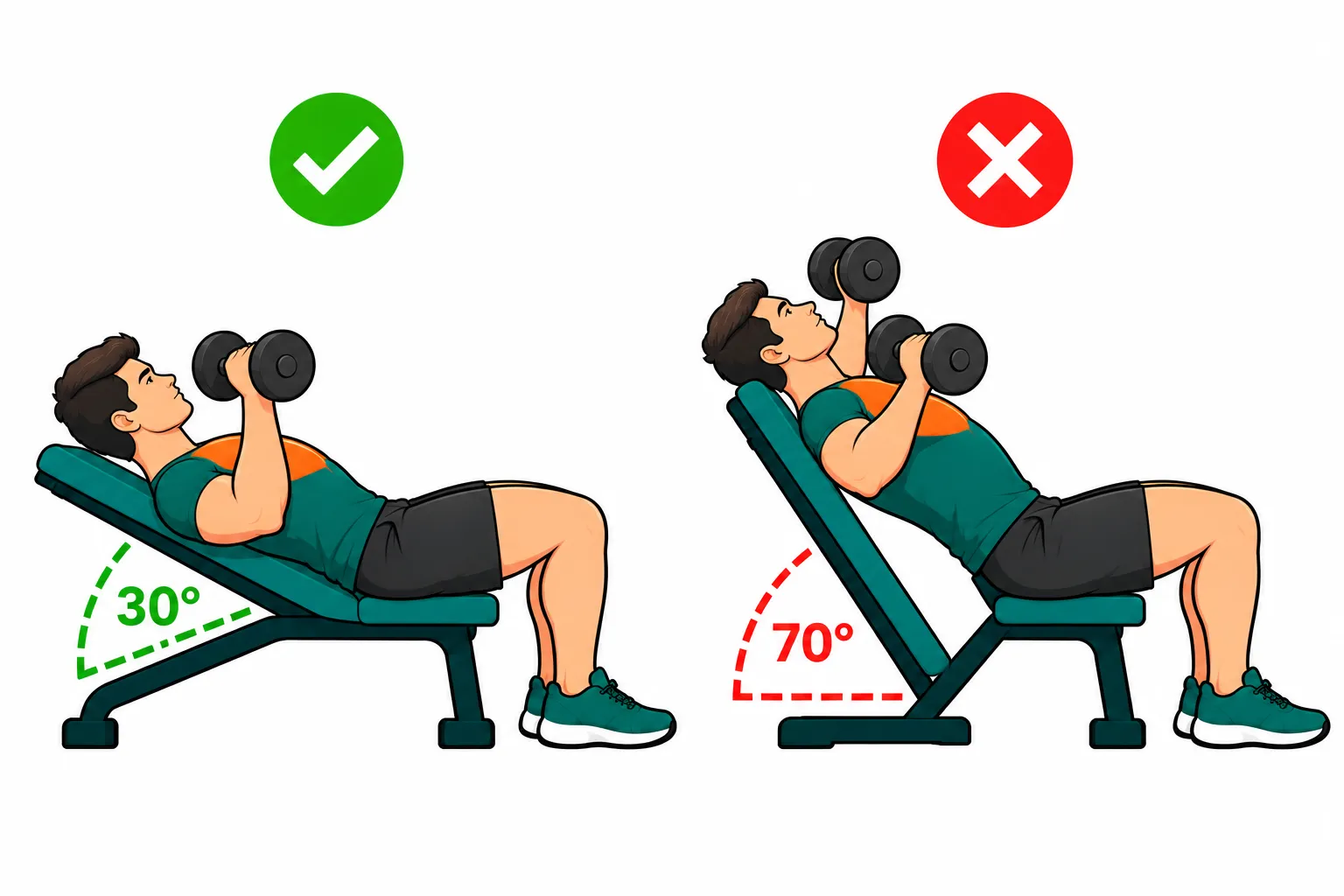
“Upper chest” is the reason most people add an incline press, and the bench angle is the thing most likely to go wrong: too flat and you are doing a bench press, too steep and the front of the shoulder is doing the pressing. The research gives a workable range.
What the incline press trains
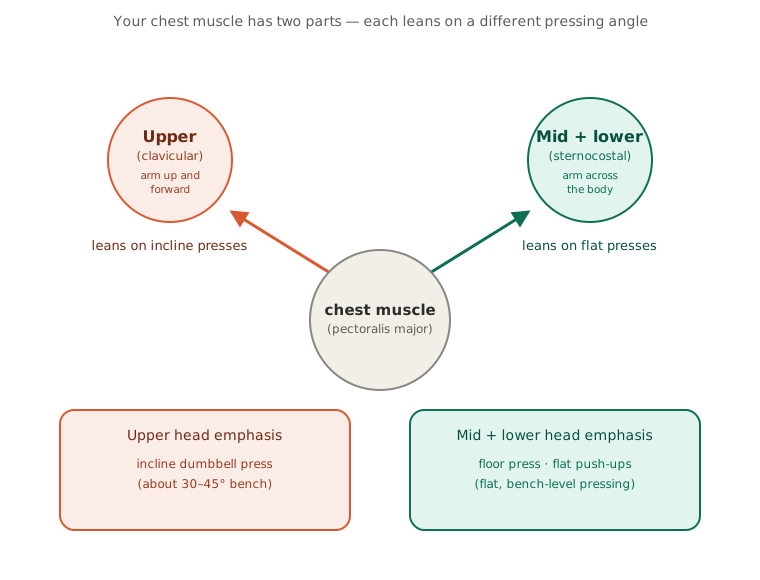
The chest muscle has an upper (clavicular) head and a middle-lower (sternocostal) head, and bench angle changes how much each one works. These are the findings from the main studies:
| Study | Participants | Angles tested | What it found |
|---|---|---|---|
| Trebs 2010 [1] | 15 men | 0°, 28°, 44°, 56° | Upper (clavicular) head greater at 44° and 56° than at 0°; sternocostal head greater at 0° than at the inclines; anterior deltoid greater at inclines than flat |
| Lauver 2016 [3] | 14 trained men | −15°, 0°, 30°, 45° | No difference for the upper chest over the whole rep, but greater activation at 30° and 45° than flat during part of the concentric phase; lower chest less active at 45° |
| Rodríguez-Ridao 2020 [2] | 30 trained adults | 0°, 15°, 30°, 45°, 60° | Upper chest peaked at 30°; middle and lower chest highest at 0°; anterior deltoid highest at 60°; above 45° the front shoulder rose and chest performance fell |
| Coratella 2020 [4] | 10 bodybuilders | −15°, 0°, 45° | Clavicular head more excited at 45°; sternocostal head more excited flat |
| Luczak 2013 [5] | 24 women, dumbbells | Flat, incline, shoulder press | Mixed: clavicular head more active in the incline eccentric phase, but flat bench more active in the concentric phase |
Two cautions. First, EMG measures how active a muscle is, not how much it will grow, so none of these studies prove that an incline builds a bigger upper chest. Second, the exact angle varies by study (30° in one, about 44–45° in others), so read it as a range, not a single number. The authors of one study concluded both flat and incline pressing are needed to recruit the whole muscle [1].
The best angle
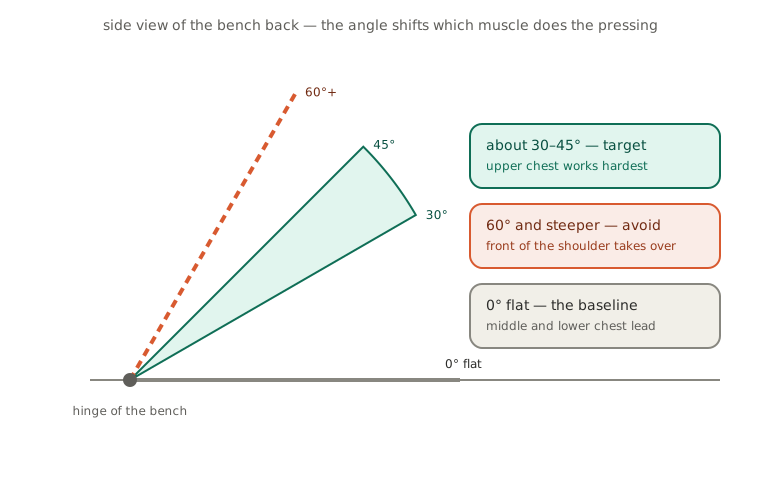
Start at about 30° and treat anything up to about 45° as acceptable. That covers the peak upper-chest activity in one study at 30° [2], the clavicular head being greater at 44° versus flat in another [1], and the 45° result in a third [4]. Past that, the work moves toward the front of the shoulder: anterior deltoid activity was highest at 60° [2], and above 45° the chest’s own performance fell [2].
How to do it
- Set the bench. Raise the back to about 30°, then sit with your back fully supported and feet flat.
- Get the dumbbells up. Rest them on your thighs, then use your knees to help lift them to shoulder level as you lie back.
- Start position. Hold the dumbbells over your upper chest with your palms facing forward or slightly angled in, and your forearms roughly vertical.
- Press. Drive up and slightly together until your arms are straight but not locked.
- Lower with control. Take 2 to 3 seconds to bring the dumbbells to the sides of your upper chest, with the elbows at about 45° from your torso.
- Keep the shoulder blades back. Do not let your shoulders roll forward as you press.
Common mistakes
- Setting the bench too steep. It becomes a shoulder press. Stay at or below about 45° [2].
- Flaring the elbows straight out. Keep them tucked at roughly 45° from the torso, which is a form cue and not a measured optimum.
- Going too heavy to control the bottom. Dumbbells have to be balanced; reduce the load before your form changes.
- Bouncing out of the bottom. Pause briefly instead.
- Doing only incline. The flat-style press loaded the middle and lower chest more in the same studies [1][2][4].
Programming the incline press
Do 3 sets of 8 to 12 reps, close to your limit with clean form. Pair it with a flat-style press such as the dumbbell floor press, and see the dumbbell chest workout at home for where it sits in a weekly plan. Because the front of the shoulder works harder on inclines [2], keep that in mind when you schedule the dumbbell shoulder workout at home.
Progress with double progression: add reps until all sets reach the top of the range, then move to the next dumbbell. The one rep max calculator plans that step for the dumbbells you own. Add the dumbbell chest fly as an optional lighter finisher.
Frequently asked questions
What is the best angle for the incline dumbbell press?
Roughly 30 to 45°. In one study the upper chest portion peaked at 30° [2], another found the upper (clavicular) head more active at 44° and 56° than flat [1], and a third found it more active at 45° than flat or declined [4]. Beyond about 45°, the front of the shoulder took more of the work [2].
Does the incline dumbbell press work the upper chest?
It appears to. Several EMG studies found greater activation of the upper (clavicular) chest at inclines of about 30 to 45° than on a flat bench [1][3][4]. One study of women using dumbbells found a more mixed pattern, with the clavicular head more active in the eccentric phase of the incline press but more active in the flat press during the concentric phase [5].
Does the incline dumbbell press work your whole chest?
It works the whole muscle, but the balance changes. In the same studies the sternocostal (middle-lower) head was more active on the flat bench than at 45° or higher [1][4]. Doing both flat and incline pressing covers more of the muscle [1].
Does the incline dumbbell press work the shoulders?
Yes, and more as the bench gets steeper. Anterior deltoid activity rose with incline and was highest at 60° in one study [2], which is why steep benches turn a chest press into more of a shoulder press.
Is the incline dumbbell press harder than flat?
Many lifters end up using lighter dumbbells than on a flat press. Anterior deltoid activity was higher at inclines than flat in several studies [1][2], so the front of the shoulder takes a larger share of the work.
Can the incline dumbbell press replace the bench press?
Not entirely. The middle and lower chest were more active on a flat bench in the same studies [1][2][4], so a flat-style press (barbell, dumbbell, or floor press) still earns a place alongside it.
How do I do the incline dumbbell press at home?
You need an adjustable bench. Set it to about 30°, hold the dumbbells over your upper chest, and press up and slightly together. If you do not have a bench, use the floor press and push-up variations instead of improvising an incline.
Which incline is best for the upper chest, 30° or 45°?
Start at 30°. It put the most activity into the upper chest in one study [2] and kept the front of the shoulder from taking over, while 45° also activated the upper head in others [1][3][4]. Treat 30 to 45° as a range and choose the angle that lets you feel the press in the chest.
Sources
- Trebs AA, Brandenburg JP, Pitney WA. An electromyography analysis of 3 muscles surrounding the shoulder joint during the performance of a chest press exercise at several angles. Journal of Strength and Conditioning Research. 2010;24(7):1925-1930. ↗
- Rodríguez-Ridao D, Antequera-Vique JA, Martín-Fuentes I, Muyor JM. Effect of five bench inclinations on the electromyographic activity of the pectoralis major, anterior deltoid, and triceps brachii during the bench press exercise. International Journal of Environmental Research and Public Health. 2020;17(19):7339. ↗
- Lauver JD, Cayot TE, Scheuermann BW. Influence of bench angle on upper extremity muscular activation during bench press exercise. European Journal of Sport Science. 2016;16(3):309-316. ↗
- Coratella G, Tornatore G, Longo S, Esposito F, Cè E. Specific prime movers' excitation during free-weight bench press variations and chest press machine in competitive bodybuilders. European Journal of Sport Science. 2020;20(5):571-579. ↗
- Luczak J, Bosak A, Riemann BL. Shoulder muscle activation of novice and resistance trained women during variations of dumbbell press exercises. Journal of Sports Medicine. 2013;2013:612650. ↗